
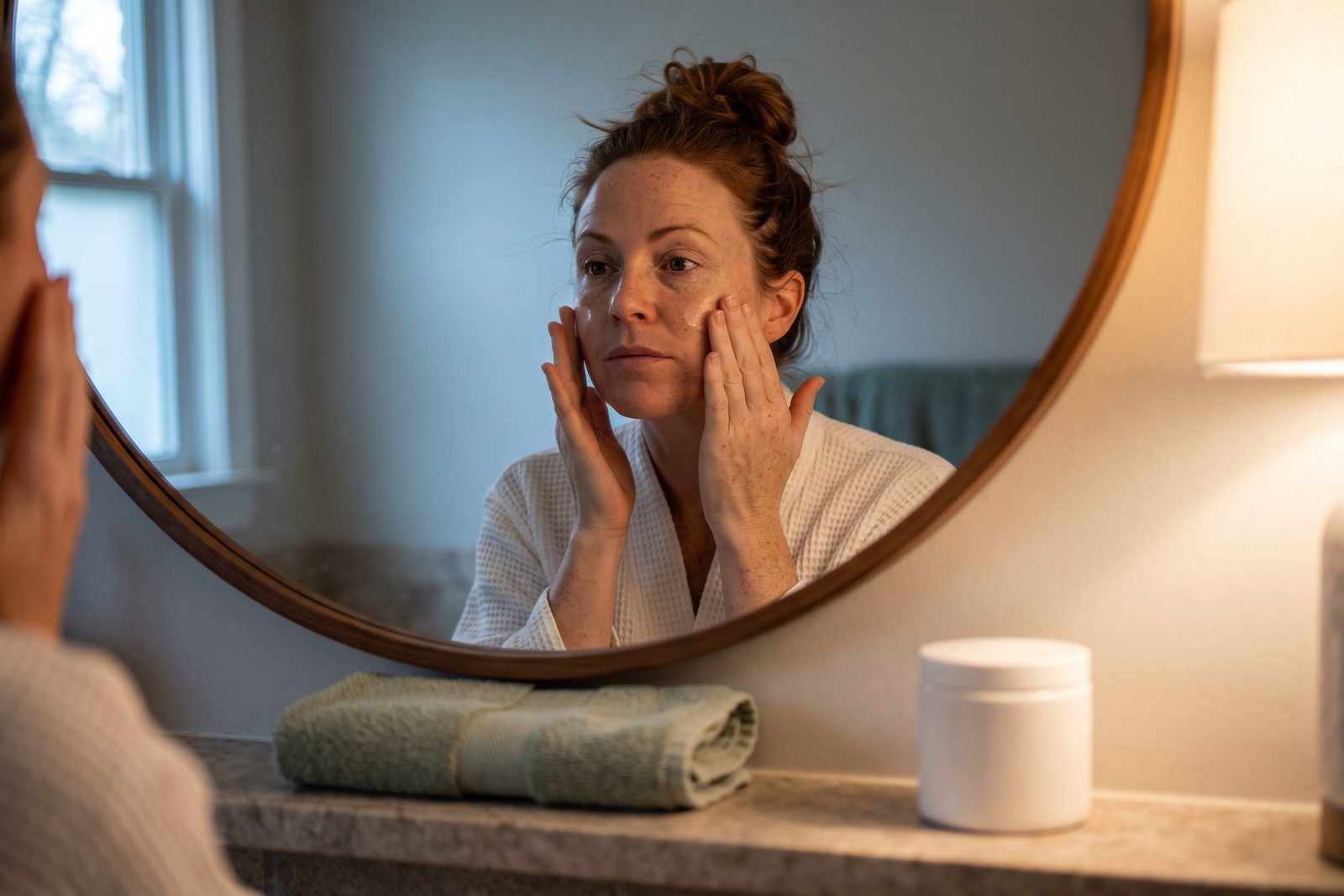
Expect redness and a sunburn-like feeling for a few days to a week, sometimes with dryness or light peeling. Collagen builds slowly, so you may see early change within a few weeks, with full results taking several months and usually a series of sessions. And 40 is not too old: study patients averaged 48, and FDA-authorized devices are for adults 22 and older.
What happens in the first 72 hours after microneedling?
For the first few days, treated skin usually looks red, or darker on deeper skin tones, and feels sunburned, sometimes with mild burning or swelling. The AAD says these reactions usually fade within a few days to a week. Most people go back to work right away but wait 24 hours before wearing makeup.
The Cleveland Clinic gives a similar picture: skin may stay red and swollen for up to five days, and an ice pack can ease irritation. The FDA lists bleeding, bruising, dryness, tightness, itching and crusting among the common effects of microneedling devices, and says most side effects show up shortly after treatment and then resolve. These signs come from the controlled injury that sets off repair, so what matters is that they ease day by day. The Cleveland Clinic says to contact your provider if the treated area bleeds for longer than 24 hours, blisters, or stays swollen for longer than a week.
Sun protection starts on day one. The Cleveland Clinic advises staying out of the sun until your skin heals, and the FDA lists planning to be in the sun in the two weeks following treatment as a reason microneedling may not suit you. If you work outdoors or have a beach weekend coming up, book around it. Your written aftercare instructions will cover cleansing and what to put on your skin.
What does week one after microneedling look like?
Week one is mostly about dryness. As redness settles, some people notice tight, dry or flaking skin, and the FDA lists peeling as a common effect. The Cleveland Clinic says dry, flaking skin usually improves with moisturizer. Resist picking or scrubbing, and follow your aftercare instructions instead of adding new active products.
How often do bothersome effects show up in studies? A 2025 systematic review of 21 facial rejuvenation studies covering 723 patients found the most often reported adverse effects were transient redness (6.8%), scaling (1.7%), burning (1.5%) and itching (0.4%). Those are rates of reported side effects; the AAD treats brief redness right after a session as an expected reaction. Less common risks on the FDA's list include pigment changes, infection and cold sore flare-ups, and the FDA notes that some side effects may be permanent.
Your skin can also be reactive that first week. The FDA lists stinging or itching when cosmetic products are applied as a known effect, so this is not the week to test a new serum or exfoliant. A gentle cleanser, a plain moisturizer and sun protection are the usual themes, and your provider's aftercare sheet is the version to follow. Our aftercare page gathers the general instructions in one place.
When will I see results from microneedling?
Results appear gradually as your body makes new collagen. The AAD says you may see improvement within a few weeks, but full results usually take several months, and the Cleveland Clinic puts the wait at 3 to 6 months. Some people need a full series of treatments before the change is clear.
A small biopsy study shows why the wait exists. In a 2015 study in the International Journal of Dermatology, 10 adults with Glogau class II to III wrinkles, a scale of sun-related aging, had six microneedling sessions two weeks apart, with skin samples taken at the start and at one and three months after treatment began. Collagen types I, III and VII, newly made collagen and tropoelastin all rose significantly. The authors noted that multiple sessions are usually needed to maintain the improvement.
That timeline means the mirror in week one can mislead you. Early days show healing, not collagen. A fair check comes several months into the process, which matches the AAD's description of full results. Taking your own photos in the same spot and light every few weeks makes slow change easier to see than day-to-day glances.
A consultation is the place to ask. Dr. Payman sees patients in Buckhead and Cumming.
How many microneedling sessions will I need?
Most plans use a series. For acne scars, the AAD says you may need 3 to 5 treatments spaced 2 to 4 weeks apart, while the Cleveland Clinic describes sessions about 3 to 8 weeks apart. A 2025 review found 19 of 21 rejuvenation studies used multiple sessions, with schedules that varied by number and timing.
Your provider will base the number on your concern and how your skin responds between visits. The AAD's schedule is specific to acne scars, while the Cleveland Clinic's wider 3 to 8 week range describes microneedling in general, so a plan for fine lines may look different from a scar plan. The table below shows a typical course from the first day to an optional yearly maintenance visit.
The FDA notes that you may need more than one procedure to reach the look you want, and it suggests questions worth asking before a series starts: how the device is cleaned between patients, and whether a new needle cartridge is used for every patient and every session. Those answers matter more over a series than in a single visit, since each session creates a fresh set of punctures.
| When | What you may notice |
|---|---|
| Day 0 to 1 | Redness or darker shading, a sunburn-like feeling, mild swelling; makeup after 24 hours |
| Days 2 to 5 | Redness and swelling easing; skin may feel tight or dry |
| Days 5 to 7 | Most redness gone for most people; some dryness or light peeling |
| Weeks 2 to 4 | Next session if you are in a series; early improvement may start |
| Months 3 to 6 | Fuller results as new collagen builds |
| Yearly | Optional maintenance session |
What does research show for acne scars and fine lines?
The evidence is strongest for indented acne scars. The AAD says a series of 3 to 5 treatments can fade acne scars by 50% to 70% in studies, and the FDA has authorized specific microneedling devices for facial acne scars and facial wrinkles. For fine lines, studies report high satisfaction, but they measure outcomes in many different ways.
The 2025 review in Aesthetic Plastic Surgery pooled 21 studies of microneedling for facial aging. Wrinkles were the most common study endpoint, and 83% of patients reported being satisfied with treatment. The authors rated it level IV evidence, a lower tier, and called for standardized outcome measures, because studies did not grade wrinkles and texture in a standard way, which makes it hard to say exactly how much change to expect.
For acne scars, add-ons tend to increase the effect. A 2024 network meta-analysis of 24 randomized trials found that combining microneedling with another treatment, such as a chemical peel or platelet-rich plasma (PRP), did better than microneedling alone. If you are deciding between treatments, our microneedling vs chemical peel guide explains how the two compare.
Is 40 too old for microneedling?
No. Forty is younger than the average patient in recent research. The FDA has authorized microneedling devices for adults aged 22 or older, and a 2025 review of 723 patients treated for facial aging reported an average age of 48. Your skin's condition and your health history usually matter more than your age.
Age does shape expectations. The AAD includes sagging skin among the concerns microneedling can diminish, but the effect builds gradually through collagen. If deeper folds or lost volume bother you most, your provider may suggest pairing microneedling with another treatment or choosing a different one, and that conversation is easier when you bring specific concerns rather than an age.
Your health history is the real screen. The AAD says to skip microneedling if you heal slowly or poorly, have had keloid scars, have a weakened immune system, are being treated for skin cancer in the area, or are receiving radiation. The FDA says it may not be suitable if you have a bleeding disorder, take blood thinners, have uncontrolled diabetes, an active skin infection or a current cold sore outbreak, have taken isotretinoin in the past 6 months, or are pregnant or breastfeeding. A microneedling consultation is where these are checked.
How many years does microneedling take off your face?
We found no study that measures microneedling in years taken off, so treat any number you see online as a guess. Research tracks scar grades, wrinkle scores, skin biopsies and patient satisfaction instead. What you can expect is gradual improvement in texture, fine lines and scars that fades over time as your body keeps losing collagen.
The AAD is clear that results fade as you lose collagen, and that people lose it at different rates. Two habits slow that loss: protecting your skin from the sun and not smoking. A maintenance session about once a year is the other lever both the AAD and the Cleveland Clinic mention.
If you golf, run outdoors or spend summer weekends on Lake Lanier, those sun hours add up. A wide-brimmed hat, shade at midday and daily sunscreen help protect the collagen you are building, during the series and long after it. For Atlanta patients, those habits are as much a part of the plan as the sessions themselves.

When is PRP or PRF added, and does it help?
PRP or PRF, made from your own blood, is sometimes added to microneedling, often for acne scars. A 2022 meta-analysis of 14 studies found that adding PRP roughly tripled the odds of more than 50% scar improvement. Using a microneedling device to deliver PRP is off-label: the FDA has not approved these devices for delivering blood products, and it says the risks of combining them with other products are not known.
That meta-analysis, in Frontiers in Medicine, pooled 472 patients, mostly from split-face studies that were not randomized, and found higher satisfaction with the combination and no significant rise in severe redness or swelling. PRF, a related preparation, has less research behind it. One 2023 split-face study of 40 patients, which injected PRF into scars before microneedling, found the treated side's average scar grade fell from 3.45 to 1.47 at 24 weeks, compared with 3.33 on the saline side.
For facial aging, the picture is mixed. A 2025 systematic review of 20 studies of PRP or PRF on its own found significant improvement in 40% of the studies that measured wrinkles and 80% of those that measured skin thickness, with no serious adverse events reported. If you are curious, ask about our PRP and PRF facial, and when you are ready to plan a series, you can book a consultation in Buckhead or Cumming.
Questions people ask
Does microneedling hurt?
Expect some discomfort. The Cleveland Clinic says you might feel warmth or a scratching sensation during treatment, with more discomfort near bony areas such as the cheekbones, and deep microneedling might cause a little bleeding. Afterward, the AAD says skin may feel sunburned for a few days to a week. Ask your provider how they keep you comfortable during the session.
When can I wear makeup after microneedling?
The AAD advises waiting 24 hours before applying makeup, and the Cleveland Clinic says most people can wear makeup the day after treatment. Skin is extra reactive in the first week, so a product you usually tolerate may sting. Use what your aftercare sheet allows.
How long does a microneedling appointment take?
It depends on the area. The Cleveland Clinic says a session can take anywhere from 15 minutes to a few hours, and describes numbing cream applied 30 to 45 minutes beforehand. The AAD gives examples: fine lines above the upper lip may take a few minutes, while stretch marks on both hips may need a 15 to 30 minute session. Ask for a time estimate at your consultation.
Is microneedling OK for darker skin tones?
The AAD describes microneedling as appropriate for all skin tones, and a 2016 review found it may have a safety advantage over traditional resurfacing in skin types IV to VI. The FDA still notes a risk of darkening or lightening in darker skin and that some devices were not studied in darker skin types, so ask about your provider's experience.
Can I use an at-home microneedling roller between sessions?
The AAD raises several concerns. At-home products are not meant to puncture the skin and give less noticeable results, and they carry risks: overuse can irritate skin, a device that does pierce the skin can cause infection or scarring, and it can spread warts, herpes and other viruses. Ask your provider what is useful at home instead.
How far ahead of an event should I start microneedling?
Work backward from the date. Redness usually clears within a few days to a week, but collagen builds over several months, and a series for acne scars may run 3 to 5 sessions spaced weeks apart. That puts the start of a series several months before a wedding or reunion. Ask your provider how close to the date your last session should be.
Sources
- Microneedling can fade scars, uneven skin tone, and more. American Academy of Dermatology, 2023. https://www.aad.org/public/cosmetic/scars-stretch-marks/microneedling-fade-scars
- Microneedling: What It Is, Uses, Benefits & Results. Cleveland Clinic, 2022. https://my.clevelandclinic.org/health/treatments/23113-microneedling
- Microneedling Devices. U.S. Food and Drug Administration, 2025. https://www.fda.gov/medical-devices/aesthetic-cosmetic-devices/microneedling-devices
- Multiple microneedling sessions for minimally invasive facial rejuvenation: an objective assessment. International Journal of Dermatology, 2015. https://pubmed.ncbi.nlm.nih.gov/26096653/
- Microneedling for Facial Rejuvenation: A Systematic Review. Aesthetic Plastic Surgery, 2025. https://pubmed.ncbi.nlm.nih.gov/40542236/
- Comparing the efficacy and safety of microneedling and its combination with other treatments in patients with acne scars: a network meta-analysis of randomized controlled trials. Archives of Dermatological Research, 2024. https://pubmed.ncbi.nlm.nih.gov/39110247/
- Combined Effect of Microneedling and Platelet-Rich Plasma for the Treatment of Acne Scars: A Meta-Analysis. Frontiers in Medicine, 2022. https://pubmed.ncbi.nlm.nih.gov/35237616/
- A Split-Face Study to Evaluate Efficacy of Autologous Injectable Platelet-Rich Fibrin With Microneedling Against Microneedling With Normal Saline (Placebo Control) in Atrophic Acne Scars. Dermatologic Surgery, 2023. https://pubmed.ncbi.nlm.nih.gov/37584506/
- Systematic Review of Platelet-Rich Plasma and Platelet-Rich Fibrin in Facial Rejuvenation. Annals of Plastic Surgery, 2025. https://pubmed.ncbi.nlm.nih.gov/40167104/
- Microneedling in skin of color: A review of uses and efficacy. Journal of the American Academy of Dermatology, 2016. https://pubmed.ncbi.nlm.nih.gov/26549251/
This article is general education and is not medical advice. It does not replace an in-person consultation. Whether a treatment suits you, and what result is realistic, depends on your health history and an examination.
Derm Clinic MD · Last updated October 2026.