

Neither one wins for every skin. Microneedling has the stronger head-to-head trial evidence for indented acne scars, while chemical peels are a long-standing choice for sun spots, uneven tone and dullness. For acne scars, studies that paired microneedling with a peel often did better than either alone. Your skin tone, your downtime and your sun plans narrow the choice.
What is more effective than microneedling?
It depends on what you are treating. For indented acne scars, a 2024 network meta-analysis of 24 randomized trials ranked microneedling combined with a chemical peel ahead of microneedling alone, peels alone and laser therapy. For deep lines, sagging or severe scarring, other tools such as laser resurfacing or scar surgery may be needed instead.
That 2024 analysis, published in Archives of Dermatological Research, pooled 1,546 participants. Microneedling paired with a chemical peel came out on top for degree of improvement, patient satisfaction and overall efficacy, and microneedling combined with other treatments did better than microneedling alone. Redness, pain and post-inflammatory hyperpigmentation (dark marks left by inflammation) did not differ significantly between treatments. A network meta-analysis compares treatments indirectly across many small trials, so read the ranking as a strong hint, not a verdict.
Some concerns sit outside what either treatment does well. The Cleveland Clinic notes that sags, deep scars, deep facial lines and more severe wrinkles do not respond well to chemical peels. The American Academy of Dermatology (AAD) adds that scar type matters: ice pick scars need different treatment than rolling scars. At Derm Clinic MD, every treatment starts with an in-person consultation, which is where acne scar treatment planning begins.
How do microneedling and chemical peels work differently?
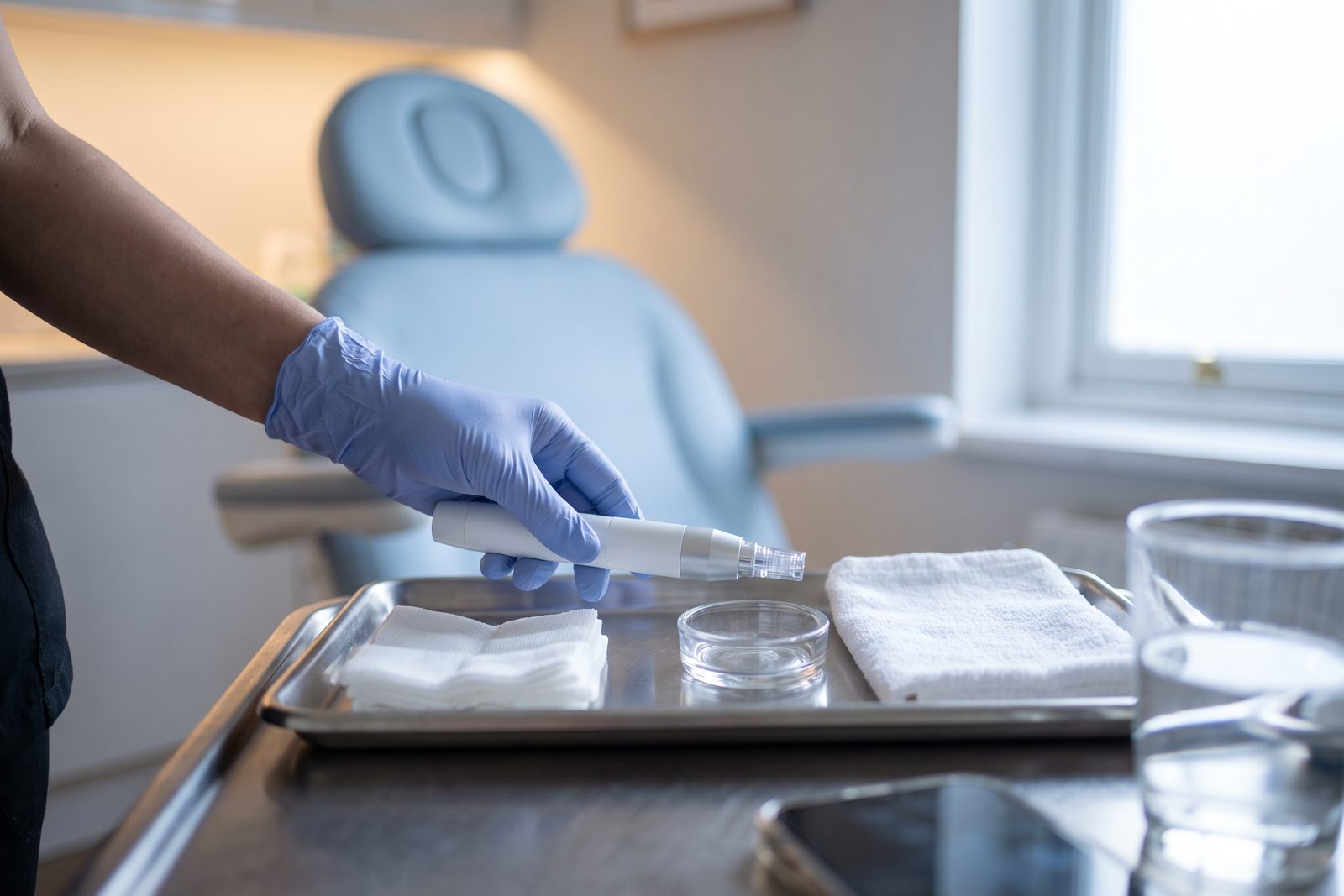
Microneedling uses tiny needles to make controlled punctures, and your skin responds by building new collagen, which is why it is also called collagen induction therapy. A chemical peel uses an acid solution to remove damaged outer layers so newer skin replaces them. How deep a peel goes depends on the chemical used.
With microneedling, the work happens below the surface. The AAD explains that as the tiny holes heal, your body fills them with collagen, which can soften scars and wrinkles and even out tone and texture. Because collagen builds slowly, change shows over weeks to months, not days. Derm Clinic MD offers microneedling with SkinPen. The FDA has authorized specific microneedling devices to improve the look of facial acne scars, facial wrinkles and abdominal scars in adults 22 and older, and each authorized device has its own specified uses.
A peel works from the top down. The Cleveland Clinic describes a light peel as removing only the outermost layer, a medium peel as reaching the upper part of the middle layer, and a deep peel as reaching the lower middle layer. Deeper means more change and a longer recovery. The AAD notes that peels also prompt the skin to make collagen and elastin. Derm Clinic MD also offers chemical peels, and your provider picks the type based on your skin and goals.
Which works better for acne scars?
For indented acne scars, microneedling has the stronger head-to-head evidence. In a 2022 randomized trial of 60 people with medium to dark skin (Fitzpatrick types IV to VI), 73% of the microneedling group improved by more than one scar grade, compared with 33% of the group treated with 35% glycolic acid peels.
Both groups in that trial, published in the Journal of Clinical and Aesthetic Dermatology, had a session every two weeks for 12 weeks. It is one trial with one peel type, and stronger acids or other schedules could perform differently. It does line up with the AAD's summary: for acne scars, you may need 3 to 5 microneedling treatments spaced 2 to 4 weeks apart, and studies have found this plan can fade acne scars by 50% to 70%.
Peels still have a role. The AAD lists chemical peels among treatments for depressed acne scars and says mild and medium peels often require more than one session. Peels are also used for blotchy or uneven tone, which is a separate problem from indented scars. If you have both texture and discoloration, that is the case for combining the two, which is covered further down.
A consultation is the place to ask. Dr. Payman sees patients in Buckhead and Cumming.
Which is better for dark spots, melasma and dull skin?
Chemical peels are the more established choice for surface color problems. The AAD lists age spots, freckles, blotchy or uneven tone, dull complexion, melasma, rough skin and sun damage among the conditions dermatologists treat with peels. Microneedling can also even out tone, but for melasma the AAD puts sun protection and prescribed creams first, with a procedure as an add-on.
Peels have a long track record: the AAD says dermatologists have performed them for more than 50 years. A light peel removes only the outer layer, which the Cleveland Clinic says suits fine wrinkling, acne, uneven skin coloring and dry, rough, sun-damaged skin. Light peels are usually done in a series, and the AAD notes 3 to 5 may be needed, repeated every 2 to 5 weeks.
Melasma needs extra care. The AAD explains that sunlight makes skin produce more pigment, which can darken existing patches, so a wide-brimmed hat, shade and broad-spectrum sunscreen are usually part of the plan. Both peels and microneedling appear on its list of procedures that can help, alongside creams your provider prescribes. If melasma is your main concern, ask how a procedure would fit with the creams and sun protection you use at home, including any medical-grade skincare.
Which carries less risk for darker skin tones?
Microneedling may carry less risk of dark marks for brown and Black skin, though neither treatment is without risk. The AAD describes microneedling as appropriate for all skin tones, and a 2016 review found it may have a safety advantage over traditional resurfacing in skin types IV to VI. Light peels can also be used in darker skin, but the AAD stresses expertise with darker skin tones, since without it pigment problems can be permanent.
The main concern in darker skin is post-inflammatory hyperpigmentation, dark patches that appear after the skin is irritated. The Cleveland Clinic notes that superficial peels can be used on all skin types, but darker skin tones have a greater risk of this darkening. The 2016 review, in the Journal of the American Academy of Dermatology, described dermabrasion, chemical peels and lasers as effective in skin of color but linked to a higher risk of pigment changes and scarring.
Peels are not off the table. A 2018 single-clinic study of 473 superficial peels in people with skin types III to VI found complications in 3.8%, most often crusting (2.3%), post-inflammatory hyperpigmentation (1.9%) and redness (1.9%), and all resolved within 8 months. Skin type VI had about five times the odds of a side effect. The FDA also cautions that microneedling can darken or lighten darker skin and that some authorized devices were not studied in darker skin types, so ask about your provider's experience with your skin tone.
How do downtime and sessions compare?
At the light end, both usually let you go straight back to your day. After microneedling, the AAD says redness or darker shading and a sunburn-like feeling usually clear in a few days to a week, and you should wait 24 hours for makeup. A light peel heals in 1 to 7 days, with possible flaking for 3 to 7 days.
Medium peels are a different commitment. The AAD describes 7 to 14 days of healing: swelling that worsens for 48 hours, possible blisters, then crusting and peeling, with camouflaging makeup allowed after 5 to 7 days and a follow-up visit required. Deep peels take 14 to 21 days, are performed in a surgical setting under general anesthesia, and can be done only once. If you are weighing a medium peel against microneedling, count that week or two of visible healing.
Sessions add up differently too. Microneedling for acne scars may take 3 to 5 treatments, and the AAD mentions a possible maintenance session once a year. Light peels often take 3 to 5 sessions, 2 to 5 weeks apart, while the Cleveland Clinic says medium peels may be repeated at 6 to 12 month intervals if needed. Ask for the whole plan, not one visit, when you compare options.
| Item | Microneedling | Light chemical peel |
|---|---|---|
| How it works | Tiny punctures prompt new collagen | Acid removes the outer layer of skin |
| Often chosen for | Indented acne scars, texture, fine lines, large pores | Age spots, freckles, uneven tone, dullness, some acne |
| Typical series | 3 to 5 sessions, 2 to 4 weeks apart (acne scars) | 3 to 5 peels, 2 to 5 weeks apart |
| Visible healing | Redness or darkening for a few days to a week | Redness, then flaking for 3 to 7 days |
| Makeup | Wait 24 hours | Usually right away or the next day |
| When change shows | Gradually, over several months | Once the skin heals, building over a series |

Can I get microneedling and a chemical peel?
Yes, and for acne scars the pairing often does better than either one alone. In the 2024 meta-analysis, microneedling combined with other treatments outperformed microneedling alone, and the peel pairing ranked first. The AAD notes that microneedling is often used along with chemical peeling. Your provider decides whether to do both at one visit or to alternate them.
In a 2022 randomized trial in Dermatologic Surgery, 40 people with acne scars had microneedling followed by either a 35% glycolic acid peel or a 15% trichloroacetic acid peel every two weeks. Both combinations improved scars about equally, and the glycolic version gave an extra gain in skin texture. One caution: the FDA says the risks of combining microneedling devices with other products are not known, so pairing them at one visit falls outside what the FDA has reviewed and is worth discussing with your provider.
Combining in the office is not a reason to do more at home. Ask which of your at-home acids, scrubs and tools to pause around treatment days, and follow the written plan you are given. The AAD notes that a skin care routine 2 to 4 weeks before microneedling can improve your response.
How should Atlanta sun change your timing?
Plan around the sun. The FDA says microneedling may not suit you if you are tan or plan to be in the sun in the two weeks following treatment, and the AAD says protecting your skin before a peel helps prevent discolored skin from developing. Medium peels call for total sun avoidance until the skin heals.
For many Atlanta patients, that points to fall and winter for a peel series. The 2018 study of superficial peels in darker skin found side effects were less common in the winter months. If your summer includes Lake Lanier weekends, beach trips or outdoor sports, schedule the active weeks of treatment around them, not in the middle. Whatever the season, the AAD says daily sunscreen once your skin heals helps you maintain results.
The simplest way to choose is to bring your exact concern (scars, spots or both) to an in-person consultation, where your skin type, your calendar and your sun habits can be weighed together. Derm Clinic MD is a physician-led med spa owned by Dr. Arshia Payman, MD, with offices in Buckhead and Cumming. When you are ready, you can book a consultation at either office.
Questions people ask
Which hurts more, microneedling or a chemical peel?
We found no head-to-head pain study, and comfort varies by person and peel depth. The AAD says microneedled skin may feel sunburned afterward, with minor discomfort, burning or swelling. The Cleveland Clinic says a peel brings a warm to somewhat hot feeling for a few minutes, then stinging that a cool compress can ease. Deeper peels are more intense, and deep peels are done under general anesthesia.
Can microneedling help with large pores?
The AAD lists large pores among the concerns dermatologists treat with microneedling, along with acne scars, dark spots, melasma, stretch marks and uneven texture. Peels are aimed more at surface tone and roughness. Because microneedling works through new collagen, any change in how pores look builds gradually over months.
Is at-home microneedling a good substitute?
The AAD raises several concerns. At-home products are not meant to puncture the skin and give less noticeable results. They also carry risks: overuse can irritate skin, a device that does pierce the skin can cause infection or scarring, it can spread warts, herpes and other viruses, and pressing too hard can change skin color or texture.
Which should I choose before a wedding or big event?
Leave room for healing. Microneedling redness usually clears in a few days to a week, but its collagen effect builds over several months, so start a series well ahead. A light peel heals in 1 to 7 days. Avoid trying a new treatment close to the date, and ask your provider to map dates backward from your event.
Who should not get microneedling?
The AAD says to skip it if you heal slowly or poorly, have or had keloid scars, have a weakened immune system, are being treated for skin cancer in the area, or are receiving radiation. It also waits for tans, sunburns, infections and painful or deep pimples to clear. Tell your provider about any isotretinoin use, past or present.
Who should not get a chemical peel?
The Cleveland Clinic says a peel may not be recommended if you have a history of abnormal scarring, have skin conditions or take medications that make your skin more sensitive, or can't stay out of the sun while healing. Tell your provider about cold sores, isotretinoin, keloids or unusual scarring, since each can change the plan or the risk.
Does insurance cover microneedling or chemical peels?
Usually not when the goal is cosmetic. The AAD states that chemical peels are considered a cosmetic treatment and that insurance does not cover cosmetic treatments, and it notes medical insurance does not cover acne scar treatment. Ask about costs at your consultation, since they depend on your plan and number of sessions.
Sources
- Microneedling can fade scars, uneven skin tone, and more. American Academy of Dermatology, 2023. https://www.aad.org/public/cosmetic/scars-stretch-marks/microneedling-fade-scars
- Chemical peels: FAQs. American Academy of Dermatology, accessed 2026. https://www.aad.org/public/cosmetic/younger-looking/chemical-peels-faqs
- Chemical peels: Overview. American Academy of Dermatology, accessed 2026. https://www.aad.org/public/cosmetic/younger-looking/chemical-peels-overview
- Acne scars: Consultation and treatment. American Academy of Dermatology, 2023. https://www.aad.org/public/diseases/acne/derm-treat/scars/treatment
- Melasma: Diagnosis and treatment. American Academy of Dermatology, 2022. https://www.aad.org/public/diseases/a-z/melasma-treatment
- Microneedling Devices. U.S. Food and Drug Administration, 2025. https://www.fda.gov/medical-devices/aesthetic-cosmetic-devices/microneedling-devices
- Chemical Peels: Types of Peels, Conditions Treated, What to Expect. Cleveland Clinic, 2021. https://my.clevelandclinic.org/health/treatments/11010-chemical-peels
- Comparing the efficacy and safety of microneedling and its combination with other treatments in patients with acne scars: a network meta-analysis of randomized controlled trials. Archives of Dermatological Research, 2024. https://pubmed.ncbi.nlm.nih.gov/39110247/
- A Comparison of Microneedling versus Glycolic Acid Chemical Peel for the Treatment of Acne Scarring. Journal of Clinical and Aesthetic Dermatology, 2022. https://pubmed.ncbi.nlm.nih.gov/35783564/
- Efficacy of Microneedling With 35% Glycolic Acid Peels Versus Microneedling With 15% Trichloroacetic Acid Peels in Treatment of Atrophic Acne Scars: A Randomized Controlled Trial. Dermatologic Surgery, 2022. https://pubmed.ncbi.nlm.nih.gov/36342251/
- Microneedling in skin of color: A review of uses and efficacy. Journal of the American Academy of Dermatology, 2016. https://pubmed.ncbi.nlm.nih.gov/26549251/
- Assessing the safety of superficial chemical peels in darker skin: A retrospective study. Journal of the American Academy of Dermatology, 2018. https://pubmed.ncbi.nlm.nih.gov/29518457/
This article is general education and is not medical advice. It does not replace an in-person consultation. Whether a treatment suits you, and what result is realistic, depends on your health history and an examination.
Derm Clinic MD · Last updated October 2026.