
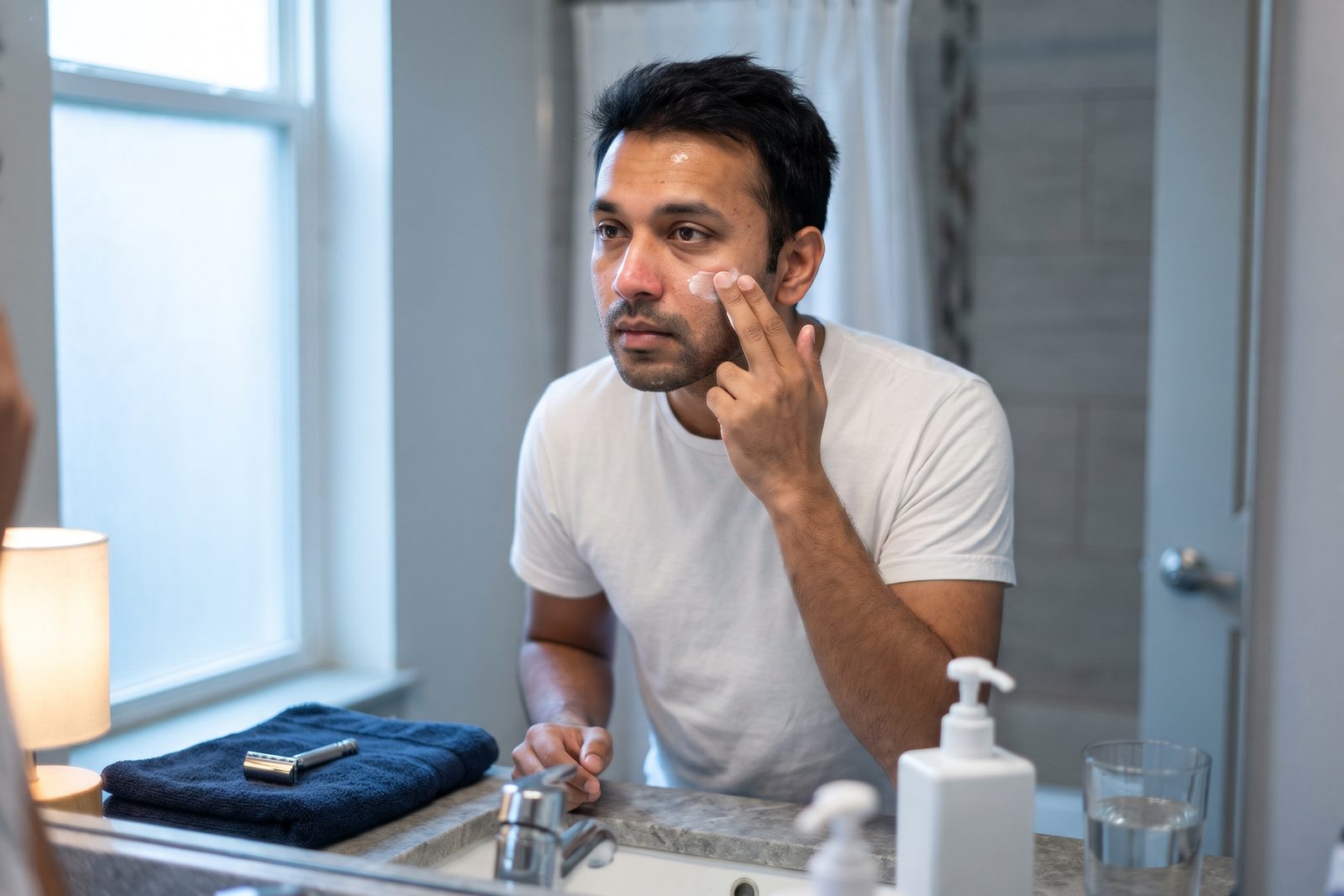
A men's skincare routine after 30 needs three steps: cleanse with a mild cleanser, treat and moisturize (a retinoid at night if it suits your skin), and protect with broad-spectrum SPF 30 or higher. The American Academy of Dermatology backs the cleansing, moisturizing and sunscreen steps, and in a 2013 randomized trial, daily sunscreen users showed 24% less skin aging.
Do men need a skincare routine?
Men need a skincare routine, but a short one. According to the American Academy of Dermatology, men should wash daily and after exercise, moisturize, and protect exposed skin with SPF 30 or higher. Men skip the last step far more than women: in a 2015 study by CDC researchers using 2013 survey data, 18.1% of men regularly used sunscreen on the face, against 42.6% of women.
Men's skin also behaves differently. A 2018 review of 57 studies found that hydration, water loss through the skin, oil (sebum), blood flow, pigmentation and thickness are generally higher in men, while skin pH is higher in women; one study in that review measured men's skin at about 10 to 20% thicker overall, across the face, neck and abdomen. Thicker, oilier skin changes which products you pick more than how many you need.
What is a simple skincare routine for men?
A simple skincare routine for men is cleanse, treat and protect: a mild cleanser with lukewarm water, a moisturizer (and at night, a retinoid if it suits you), and broad-spectrum sunscreen of SPF 30 or higher each morning. The American Academy of Dermatology advises applying moisturizer right after washing or shaving, while the skin is still damp.
That takes about two minutes a day. A moisturizer with SPF 30 or higher can cover two steps in the morning, and if you only manage one step, make it the sunscreen. Toners, serums and eye creams are optional extras, not the base. If you want products chosen for your skin, our medical-grade skincare page covers what Derm Clinic MD offers.
| Step | When | What it does | What to look for |
|---|---|---|---|
| Cleanse | Morning, night and after exercise | Removes sweat, oil and sunscreen | A mild facial cleanser and lukewarm water; regular bar soap can be drying |
| Treat and moisturize | Moisturizer morning and night on damp skin; a retinoid at night only | Moisturizer traps water in the skin; a retinoid works on fine lines and uneven tone | Oil-free or non-comedogenic if you break out; retinol, or a prescription retinoid after a consultation |
| Protect | Before you go outside; reapply every 2 hours and after sweating | Slows sun damage | Broad-spectrum, water-resistant, SPF 30 or higher |
Why does sunscreen matter so much for men's skin?
Sunscreen matters for men's skin because daily use has direct randomized-trial evidence against skin aging, and men use it far less than women. In a 2013 randomized trial of 903 adults in Australia, published in Annals of Internal Medicine, the daily sunscreen group showed no detectable increase in skin aging after 4.5 years, and aging was 24% less than in the group that used sunscreen when they chose.
The American Academy of Dermatology recommends a broad-spectrum, water-resistant sunscreen with an SPF of 30 or higher on all exposed skin, including the scalp, ears, neck and lips, reapplied every two hours and right after swimming or sweating. For a man who runs, golfs or coaches through an Atlanta summer, the reapplying is the part that slips. The same page notes that men over 50 have a higher melanoma risk than the general population.

A consultation is the place to ask. Dr. Payman sees patients in Buckhead and Cumming.
Should men use retinol or a prescription retinoid?
Men can start with retinol, but a prescription retinoid has the stronger evidence. A retinoid is a vitamin A based ingredient used to soften fine lines and uneven tone over time. According to a 2022 review in Advances in Therapy, tretinoin is considered the most effective retinoid with proven anti-aging effects and comes in approved prescription medicines, while retinol and other cosmetic retinoids lack well-designed trials to back their claims.
Retinoids can also irritate; the same review lists instability, low penetration and skin irritation as their main drawbacks. If a drugstore retinol leaves you red and flaky, or does little after a fair trial, a prescription retinoid is worth asking about. At Derm Clinic MD, a prescription product, if it fits, is prescribed after the consultation; follow your prescriber's written directions on how to start it. The practice offers cosmetic care only, so acne that needs medication is a job for a doctor who treats medical skin conditions first.
How should men shave to protect their skin?
Men protect their skin when shaving by softening the hair first and cutting with the grain. According to the American Academy of Dermatology, wet your skin and hair, use a moisturizing shaving cream, shave in the direction of hair growth and change the blade after five to seven shaves. If you get razor bumps, a single- or double-blade razor may help.
Pseudofolliculitis barbae, better known as razor bumps, is a chronic inflammatory condition that causes bumps and pustules mainly on the beard and neck. A 2023 review notes that it predominantly affects people with skin of color, that topical therapies are the mainstay of treatment, and that laser hair removal is being studied as a longer-term option. Bumps that keep coming back after you change your shave are worth a medical visit, not just a new razor.
What should change your skincare routine?
A man's skincare routine changes with what his skin is doing, not with age alone. According to the American Academy of Dermatology, no one-size-fits-all approach exists, so start from the three steps and adjust one thing at a time when you notice shine, stinging, razor bumps, lines at rest, long hours outdoors or a spot that changes.
Change one thing at a time and give it a few weeks before you judge it, so you can tell what helped and what irritated. Stacking three new products in one week makes it hard to know which one caused a reaction, and the fix is usually to drop the newest product rather than the whole routine.
- Shiny by noon or breaking out: switch to oil-free or non-comedogenic products before adding anything new.
- Stinging or redness: choose mild, fragrance-free products; the AAD warns that unscented products may still contain masking fragrance.
- Razor bumps: change how you shave first, then ask about treatment if they keep coming back.
- Lines that stay when your face is relaxed: a routine slows new damage, and an in-office option may be the next step.
- Outdoor work or sport: reapply sunscreen every two hours and right after sweating, and add a hat.
- A new spot, or one that itches, bleeds or changes color: see a doctor who does skin checks, since the AAD lists these as possible early signs of skin cancer.
When does a man need more than a skincare routine?
A man needs more than a skincare routine when the concern is a deep line, a scar or rough texture that products reach slowly or not at all. Daily sunscreen and a retinoid slow new damage, but a frown line that stays at rest or acne scarring usually calls for an in-office option such as Botox, microneedling or a chemical peel.
Neurotoxins relax the muscle behind a frown or forehead line, and our guide to Botox for men covers how dosing and brow shape differ for men. Microneedling, done at Derm Clinic MD with SkinPen, and chemical peels work on texture and tone; for peels, type, strength and number of visits are set at your consultation. Our treatments for men page lists the rest. Skin checks, moles, rashes and acne medication sit outside the practice's cosmetic care.
What happens at a skincare consultation at Derm Clinic MD?
A skincare consultation at Derm Clinic MD happens in person with Dr. Arshia Payman at the Buckhead (Atlanta) or Cumming office. Dr. Payman asks what bothers you, reviews your health history, medications and past treatments, looks at your skin at rest and in motion, explains what each option can and cannot do, and prescribes a product only if it fits.
If you're coming in for the first time, first Dr. Payman likes to understand exactly what bothers you about your skin, so the visit starts with conversation, not products. If you'd rather fix your routine before any treatment, say so. If you already know you want microneedling or Botox, you can book online (opens in a new tab), and the visit still starts with the consultation.
- Consult first: Dr. Payman asks what bothers you and what you want instead before any product or treatment is named, so that the plan fits your concern, whether that is shine, razor bumps or lines. You do most of the talking at this stage.
- Your history: she reviews your health history, medications, supplements and past treatments, so that nothing she suggests clashes with what you already use. It helps to bring the names of the products on your bathroom shelf.
- Your skin at rest and in motion: she looks at your face relaxed and asks you to frown, smile and raise your brows, so that she can tell dynamic lines from static ones. Photos are usually taken for your chart.
- The honest options: you hear what each option can and cannot do, the risks, the recovery and the cost, so that you can weigh a better routine against an in-office treatment. Sometimes the honest answer is less, or not yet.
- Prescription, if it fits: a prescription product is prescribed after the consultation only if it suits your skin, so that it is added only when your routine needs it. You leave knowing whether you need one.
- Your choice of timing: you sign consent only if you go ahead, and you don't have to be treated that day. That way you can try the routine for a few weeks first and decide later.
- Aftercare: if you are treated, you leave with written aftercare, and the office is a phone call away, so that you know what is normal and whom to call if something feels wrong.
Questions people ask
Do men need a different skincare routine than women?
Men need the same three steps, cleanse, treat and protect, but often different products. A 2018 review found men's skin is generally oilier, thicker and more pigmented than women's, so oil-free or non-comedogenic products may suit many men better. Shaving also adds a step that most routines written for women leave out.
What is a 5-step skincare routine for men?
A 5-step routine usually adds a toner or serum and an eye cream to cleanser, moisturizer and sunscreen. Those extras are optional. The American Academy of Dermatology's advice for men centers on washing, moisturizing, shaving well and daily sun protection, and it notes there is no one-size-fits-all approach. Start with three steps and add only what solves a problem you have.
Is bar soap fine for a man's face?
Often it is too harsh. The American Academy of Dermatology notes that regular bar soap can be drying and suggests a mild facial cleanser with lukewarm, not hot, water. Wash daily and after exercise. If your skin feels tight or flaky after washing, the cleanser is the first thing to change.
Do men need sunscreen under a beard?
Yes, on any skin the beard leaves exposed. Most beards leave the forehead, nose, upper cheeks, ears and neck uncovered, and the American Academy of Dermatology says to apply sunscreen to all exposed skin, including the scalp, ears, neck and lips. A lightweight lotion or gel is easier to work through facial hair.
Does drinking more water improve a man's skin?
Drinking enough water matters for your health, but it does not replace the three steps. The American Academy of Dermatology's advice for men's skin centers on a mild cleanser, a moisturizer applied to damp skin and daily broad-spectrum sunscreen. Our separate post on drinking water and skin covers what the research shows.
How long before a skincare routine makes a difference?
Moisturizer changes how your skin feels right away. Sun protection works on a longer clock: in the 2013 Australian trial, the daily sunscreen group showed no detectable increase in skin aging after 4.5 years. Retinoids sit in between, and how quickly they help depends on the product and your skin.
Do men need facials?
A facial is optional. It can feel good and clean the skin, but it does not replace daily sunscreen and a retinoid. If your concern is texture, rough patches or old acne marks, in-office treatments such as microneedling or a chemical peel, planned at a consultation, are built for that job.
Sources
- Skin care tips for men. American Academy of Dermatology, accessed 2026. https://www.aad.org/public/everyday-care/skin-care-basics/care/skin-care-for-men
- Patterns of sunscreen use on the face and other exposed skin among US adults (Holman DM, et al.). Journal of the American Academy of Dermatology, 2015. https://pubmed.ncbi.nlm.nih.gov/26002066/
- Sunscreen and prevention of skin aging: a randomized trial (Hughes MC, et al.). Annals of Internal Medicine, 2013. https://pubmed.ncbi.nlm.nih.gov/23732711/
- Male versus female skin (Rahrovan S, et al.). International Journal of Women's Dermatology, 2018. https://pmc.ncbi.nlm.nih.gov/articles/PMC6116811/
- Use of Retinoids in Topical Antiaging Treatments: A Focused Review of Clinical Evidence for Conventional and Nanoformulations (Milosheska D, Roskar R). Advances in Therapy, 2022. https://pmc.ncbi.nlm.nih.gov/articles/PMC9618501/
- Review of treatments for pseudofolliculitis barbae (Dalia Y, et al.). Clinical and Experimental Dermatology, 2023. https://pubmed.ncbi.nlm.nih.gov/36840647/
This article is general education and is not medical advice. It does not replace an in-person consultation. Whether a treatment suits you, and what result is realistic, depends on your health history and an examination.
Derm Clinic MD · Last updated November 2026.