
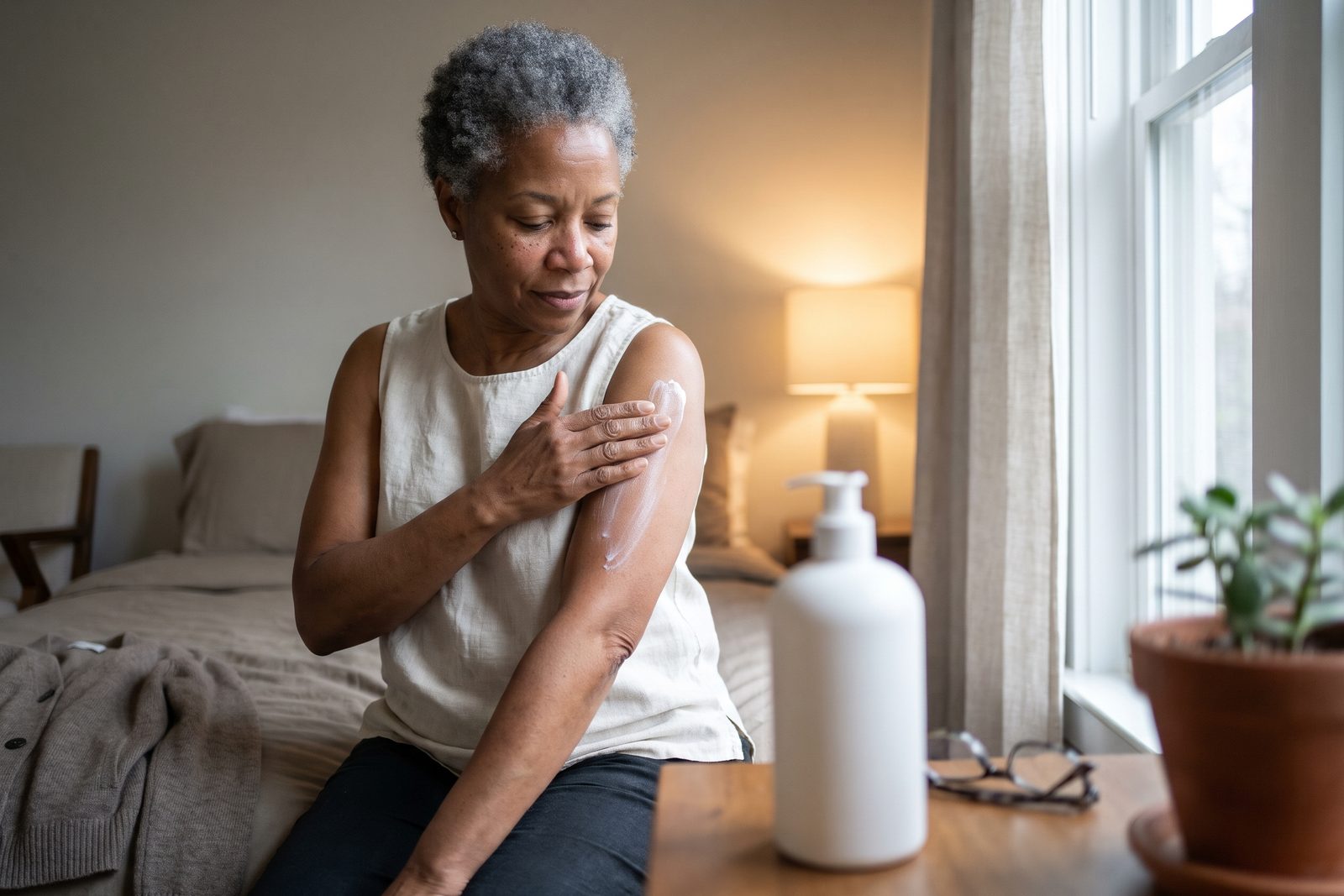
Crepey skin is thin, finely wrinkled skin with a crepe paper look, caused mostly by sun damage and the age-related loss of collagen and elastin. Daily sunscreen and a retinoid slow it and improve it modestly. Collagen-building treatments such as microneedling, CO2 laser and Sculptra improve texture further, while loose, hanging skin usually needs surgery.
What is crepey skin, and what causes it?
Crepey skin is skin that has thinned and developed fine wrinkles, which Cleveland Clinic says gives it a crepe paper-like appearance, most often under the eyes and on the arms. According to Cleveland Clinic, sun exposure, which breaks down elastin, is a main cause, along with age, weight changes, dry skin and certain medications such as long-term prednisone.
Elastin is the protein that lets skin stretch and spring back, while collagen gives it strength. MedlinePlus, the National Library of Medicine's health site, explains that with age the outer skin layer thins, connective tissue changes reduce strength and elasticity, and the fat layer underneath thins. It calls sun exposure the greatest single factor in skin aging, and it notes that this loss of elasticity, called solar elastosis, is more noticeable on sun-exposed skin.
Cleveland Clinic says crepey skin usually begins to appear in your 40s, but it can show up in your 20s in frequent tanning bed users or people who have gained and lost substantial weight. Dry skin is on its list of causes, which is why a good moisturizer improves how crepey skin looks without rebuilding collagen.
Can crepey skin really be fixed?
Crepey skin can usually be improved but not fully reversed, because sun-damaged collagen and elastin are only partly rebuilt. A 2026 review in Dermatologic Surgery found that biostimulatory fillers, used off the face for thinning and crepiness, improve skin quality and laxity through collagen stimulation, and it stressed realistic expectations. Most people see a smoother surface, not lifted skin.
It helps to think in levels, from the cheapest and slowest step to the most invasive. Each level does a different job, and moving up a level only makes sense when the one below is already in place.
- Protect: daily broad-spectrum sunscreen and clothing that covers, so new damage stops adding to the old.
- Improve slowly at home: a retinoid and a good moisturizer, which change texture modestly over months.
- Build collagen in the office: microneedling, CO2 laser or a microlaser peel, biostimulators such as Sculptra or Radiesse, and skin boosters, judged over a series of visits.
- Remove loose skin: surgery such as a neck lift or arm lift, when skin hangs rather than crinkles.
What can creams and sunscreen do for crepey skin?
Creams and sunscreen do modest but real good for crepey skin. In a 2007 randomized trial in Archives of Dermatology, 36 older adults had a retinol lotion on one arm and a plain lotion on the other for 24 weeks, and the retinol arm showed significantly less fine wrinkling, with more collagen production in a small set of skin samples.
Cleveland Clinic likewise recommends retinol creams for the crepey look, plus moisturizers with alpha or beta hydroxy acids or hyaluronic acid. At Derm Clinic MD, a prescription product, if it fits, is prescribed after the consultation, as our medical-grade skincare page explains. Extra water is not on the list, as our post on drinking water and your face explains.
Sunscreen protects everything else you do. In a 2013 randomized trial of 903 adults under 55 in Australia, the daily sunscreen group showed no detectable increase in skin aging over 4.5 years, and aging was 24% less than in the group using sunscreen at will. Beta-carotene supplements had no overall effect. Cleveland Clinic advises daily broad-spectrum sunscreen of at least SPF 30, ideally SPF 50 or higher, plus sun-protective clothing outdoors.
A consultation is the place to ask. Dr. Payman sees patients in Buckhead and Cumming.
Which in-office treatments build collagen for crepey skin?
In-office treatments for crepey skin work by prompting new collagen. Microneedling and CO2 laser do it from the surface, while biostimulators such as Sculptra and Radiesse do it from beneath. According to the FDA, Sculptra is approved for fine lines and wrinkles in the cheek region, and a diluted form of Radiesse was approved in 2026 for chest wrinkles.
A biostimulator is an injectable that prompts your body to build its own collagen gradually, rather than filling a line on the spot. Sculptra is poly-L-lactic acid, and its FDA approvals include fine lines and wrinkles in the cheek region (2023). Radiesse is calcium hydroxylapatite, and in March 2026 the FDA approved Radiesse diluted with saline for wrinkles of the décolleté, the upper chest. In a 2026 open-label study of 30 women, most improved on a chest wrinkle scale nine months after a Sculptra series. See our Sculptra page and Radiesse page.
A skin booster is a thin hyaluronic acid gel injected into the skin to improve smoothness rather than add volume. The FDA approved SkinVive in 2023 for cheek smoothness and in June 2026 to reduce neck lines. Microneedling has its own clearance: the FDA cleared the SkinPen Precision system in 2021 for neck wrinkles in skin types II to IV and facial acne scars. In its neck study of 35 people aged 44 and older, average wrinkle scores improved significantly three months after four monthly treatments, though only half improved by a full grade.
In a 2014 study of 20 people given fractional CO2 laser over the whole neck, laxity and horizontal neck line scores were significantly lower at one month and still at one year. At Derm Clinic MD, laser starts with a consultation, and the instructions include no sun or tanning lamps beforehand and strict sun protection afterward.
What helps crepey skin on the face, neck, chest and arms?
What helps crepey skin depends on the area, because the evidence differs by body part. The cheeks, neck and chest each have at least one treatment with FDA approval or clearance for that area, and the arms have trial evidence for retinol lotion. A 2026 review in Dermatologic Surgery says careful patient selection and individualized technique are essential when biostimulators are used off the face.
Arms are where expectations matter most. Biostimulators are also used on the upper arms, and the 2026 review based its off-face guidance on published studies, consensus recommendations and clinical experience. Whether an off-face area such as the arms is a good use of your budget is a question for your consultation. Crepey skin on the backs of the hands usually comes with volume loss and sun spots, covered on our hand rejuvenation page.
Two neck problems often get confused. Crepey neck skin is a surface texture, while vertical neck bands come from the platysma muscle and need a different approach. The SkinVive and SkinPen neck data address lines, not bands. Loose skin under the jaw is laxity, and significant sagging is better matched to a surgeon.
| Area | Options to ask about first | Other options to ask about | A realistic goal |
|---|---|---|---|
| Face (cheeks) | Sculptra (FDA-approved for cheek fine lines and wrinkles); SkinVive for cheek smoothness | CO2 laser or a microlaser peel, chemical peels, microneedling, a retinoid | Smoother texture over months |
| Neck | SkinPen microneedling (FDA-cleared for neck wrinkles, skin types II to IV); SkinVive for neck lines | Fractional CO2 laser; Sculptra or Radiesse | Fewer fine lines; bands need a different plan |
| Chest (décolleté) | Radiesse, diluted (FDA-approved for chest wrinkles in 2026) | Sculptra; chemical peels | Softer crinkling, built over a series |
| Arms | Retinol lotion and daily sunscreen | Sculptra or Radiesse | Modest change; hanging skin needs surgery |
What happens at a crepey skin consultation at Derm Clinic MD?
A crepey skin consultation at Derm Clinic MD is an in-person visit with Dr. Arshia Payman at the Buckhead (Atlanta) or Cumming office. She asks which area bothers you, reviews your history, looks closely at the skin and explains what each option can and cannot do before anything is planned.
If one area bothers you most, such as your neck or chest, start there and say so. If several areas bother you, the first visit can set the order. And if your main concern turns out to be loose, hanging skin rather than crinkled texture, you will hear that too, because significant sagging is better matched to a surgeon.
- Consult first: Dr. Payman asks what bothers you and what you want instead, before any treatment is named, so the plan fits your goal rather than a menu. You describe the area and how long it has bothered you.
- Your history: She reviews your health history, medications, supplements and past treatments, so that anything affecting thin skin or healing is on the table. Mention long-term steroid use, big weight changes and any earlier filler or laser.
- Looking at the skin: She looks closely at the area you point to, including your face at rest and in motion, and photos are usually taken for your chart, so that change can be judged later against a fair starting point. Texture improves slowly, and photos make slow change easier to see.
- The honest answer: You hear what each option can and cannot do, the risks, the recovery and the cost, and sometimes the answer is less, or not yet. That way your money goes to a treatment that can deliver what you want, and you do not have to be treated that day.
- Mapping the plan: With Sculptra or Radiesse, results build gradually, so she reviews the area over the following weeks before another session. For skin boosters, she explains whether SkinVive or VAMP suits your skin. You leave knowing the first step, if there is one.
- Skincare at home: If a prescription product fits, it is prescribed after the consultation, so that your daily routine supports the in-office work between visits.
- Aftercare: Every treatment comes with written aftercare, and the office is a phone call away, so questions in the first days get a quick answer. The office also confirms your cost before any treatment.
What tightens crepey skin on the arms naturally?
Nothing natural tightens crepey arm skin much, but daily habits keep it from getting worse. Sun protection, moisturizer and a retinoid lotion help texture, and strength training builds the muscle underneath. The American Society of Plastic Surgeons says sagging upper arms cannot be corrected through exercise, which is when an arm lift comes up.
For arms, the sunscreen advice matches the face: broad spectrum, SPF 30 or higher, reapplied outdoors, plus sleeves or sun-protective clothing, which Cleveland Clinic also recommends. The 2007 retinol trial was done on the arm, so that evidence applies directly.
The American Society of Plastic Surgeons says an arm lift may be right for you if the undersides of your upper arms sag or look loose and full from excess skin and fat. If your arm skin crinkles but does not hang, home care and, if you choose, collagen-building treatment are the realistic route. If it hangs, a plastic surgeon is the right next opinion.
How do you choose a crepey skin plan, and what should you ask?
Choosing a crepey skin plan starts with naming the problem: crinkled texture, lost volume or loose skin. Texture responds to collagen-building treatments, volume to biostimulators or filler, and loose skin to surgery. Most plans pair daily sun protection with one in-office treatment judged over months, and a 2026 review in Dermatologic Surgery stresses realistic expectations.
Cost depends on the size of the area, the product and amount used, and the number of sessions, and the office confirms your cost before any treatment. For filler and laser, your first visit is a consultation. If thin skin is not your main issue, our guides to smoker's lines and large pores cover two other texture concerns. When you are ready, book a consultation (opens in a new tab) and bring these questions:
- Is my concern texture, volume or loose skin?
- Which option fits the area that bothers me most, and why?
- How many sessions, how far apart, and when will we judge the change?
- What recovery should I plan around?
- What do I do at home between visits?
Questions people ask
What is the one vitamin you need after 60 for crepey skin?
No single vitamin fixes crepey skin. The vitamin A form with trial evidence here is applied to the skin, not swallowed: in a 2007 trial in adults averaging 87, retinol lotion improved fine wrinkling on the arm. A 2013 trial found beta-carotene supplements had no overall effect on skin aging.
Can crepey arm skin be reversed?
Partly. Retinol lotion improved fine wrinkling on the arm in a 2007 trial, and Sculptra and Radiesse are also used on the arms to build collagen, with limited published support. If the skin hangs, the American Society of Plastic Surgeons describes an arm lift as the surgical option.
Can I have Sculptra on my neck or chest?
Sculptra has been studied on the chest: in a 2026 study of 30 women, most improved on a chest wrinkle scale nine months after a series. A diluted form of Radiesse was FDA-approved in 2026 for chest wrinkles, SkinVive is FDA-approved for neck lines, and SkinPen is cleared for neck wrinkles in skin types II to IV. Ask at your consultation which option fits your area.
How long before collagen-building treatments show a change?
Expect weeks to months. Collagen builds slowly, so studies judge results late: the SkinPen neck study measured change three months after the last of four sessions, and a 2026 Sculptra chest study measured it at nine months. Judge your own result on that slower clock.
Does weight loss make crepey skin worse?
It can. Cleveland Clinic lists weight changes among the causes of crepey skin and says it can appear as early as your 20s in people who have gained and lost substantial weight. If you are losing weight now, sun protection and moisturizer help, and a treatment plan is easier to judge once your weight is stable.
Is crepey skin a sign of a medical problem?
Usually not. Most crepey skin comes from sun and age, though Cleveland Clinic notes that long-term use of medicines such as prednisone can contribute. Derm Clinic MD provides cosmetic care only, so new rashes, changing spots or skin that tears easily should be checked by a doctor who treats medical skin conditions.
Does microneedling help crepey skin?
It can help some areas. The FDA cleared the SkinPen microneedling system in 2021 to improve the appearance of neck wrinkles in skin types II to IV and facial acne scars, and in its neck study half of graded participants improved by at least one wrinkle grade. Derm Clinic MD uses SkinPen, and you can book microneedling online.
Sources
- Have Crepey Skin? Here's How You Can Address It. Cleveland Clinic, 2024. https://health.clevelandclinic.org/whats-causing-your-crepey-skin-and-how-can-you-fix-it
- Aging changes in skin. MedlinePlus, U.S. National Library of Medicine, reviewed 2024. https://medlineplus.gov/ency/article/004014.htm
- Improvement of naturally aged skin with vitamin A (retinol) (Kafi R, et al.). Archives of Dermatology, 2007. https://pubmed.ncbi.nlm.nih.gov/17515510/
- Sunscreen and prevention of skin aging: a randomized trial (Hughes MC, et al.). Annals of Internal Medicine, 2013. https://pubmed.ncbi.nlm.nih.gov/23732711/
- The FDA-Approved and Non-FDA-Approved Indications for Biostimulatory Fillers off the Face (Butterwick KJ, et al.). Dermatologic Surgery, 2026. https://pubmed.ncbi.nlm.nih.gov/42975435/
- Premarket approval P030050/S039: Sculptra. U.S. Food and Drug Administration, 2023. https://www.accessdata.fda.gov/scripts/cdrh/cfdocs/cfpma/pma.cfm?id=P030050S039
- Premarket approval P050052/S162: Radiesse Injectable Implant, décolleté wrinkles. U.S. Food and Drug Administration, 2026. https://www.accessdata.fda.gov/scripts/cdrh/cfdocs/cfpma/pma.cfm?id=P050052S162
- Safety and Effectiveness of Two Reconstitution Volumes of Poly-L-Lactic Acid for Correction of Décolletage Wrinkles (Joseph J, et al.). Journal of Drugs in Dermatology, 2026. https://pubmed.ncbi.nlm.nih.gov/42235050/
- Premarket approval P110033/S099: SkinVive by Juvederm. U.S. Food and Drug Administration, 2026. https://www.accessdata.fda.gov/scripts/cdrh/cfdocs/cfpma/pma.cfm?id=P110033S099
- 510(k) summary K202243: SkinPen Precision System. U.S. Food and Drug Administration, 2021. https://www.accessdata.fda.gov/cdrh_docs/pdf20/K202243.pdf
- Neck Rejuvenation with Fractional CO2 Laser: Long-term Results (Oram Y, Akkaya AD). Journal of Clinical and Aesthetic Dermatology, 2014. https://pubmed.ncbi.nlm.nih.gov/25161757/
- Arm Lift. American Society of Plastic Surgeons. https://www.plasticsurgery.org/cosmetic-procedures/arm-lift
This article is general education and is not medical advice. It does not replace an in-person consultation. Whether a treatment suits you, and what result is realistic, depends on your health history and an examination.
Derm Clinic MD · Last updated November 2026.