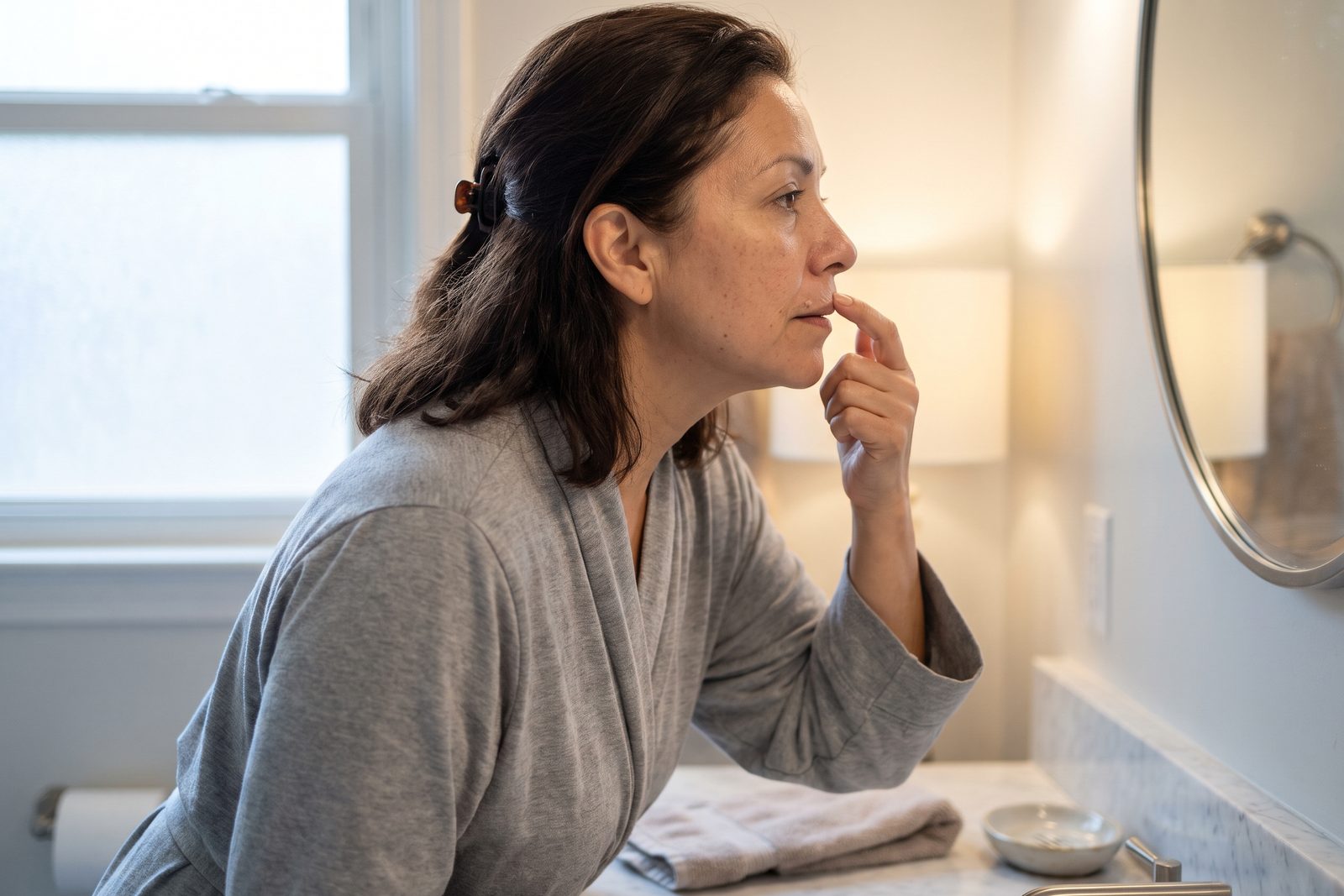
Smoker's lines, the vertical lines on and above the upper lip, can usually be softened but rarely erased. Fine lines often respond to a chemical peel, laser or microneedling. Etched and deep lines usually need a soft hyaluronic acid filler, a type the FDA has approved for lines around the mouth, often combined with resurfacing over several months.
What are smoker's lines, and what causes them?
Smoker's lines are vertical wrinkles on the lips and above the upper lip, and Cleveland Clinic says they are also called lip lines or lipstick lines and usually develop around your 40s. Despite the name, nonsmokers get them too. According to Cleveland Clinic, the underlying cause is the muscle around the mouth, which becomes more active with time.
Perioral rhytids is the medical term for wrinkles around the mouth, and it is the wording the FDA uses on filler approvals. The orbicularis oris is the ring of muscle that closes and puckers your lips. Each time you purse or sip through a straw, it folds the thin skin above it. As sun and age wear down collagen and elastin, the folds start to stay. Cleveland Clinic also lists smoking, sun damage, genetics, excess alcohol and poor sleep as contributors.
Smoking does make them worse. A 2013 study of 79 pairs of identical twins, published in Plastic and Reconstructive Surgery, found that the smoking twins had worse upper lip wrinkles than their nonsmoking siblings, along with worse scores for nasolabial folds and jowls. Its authors concluded that a five-year difference in smoking history can cause noticeable differences in facial aging.
Is it possible to get rid of smoker's lines?
Smoker's lines can usually be softened, often a lot, but erasing them completely is uncommon. Cleveland Clinic says lip lines do not go away on their own and that treatments reduce or temporarily improve them. Your type of line, fine, etched or deep, decides which treatment fits, and most people do well with a combination over several months.
A simple mirror test sorts your lines. Relax your mouth completely and look in daylight. Lines that vanish at rest are dynamic: they form only when the muscle moves. Lines still visible at rest are etched into the skin. If your upper lip has also thinned or its border has flattened, volume loss is part of the picture. The table below maps each pattern to what usually helps.
Expect maintenance. Cleveland Clinic notes that Botox may last up to six months, and that improvement after laser resurfacing may continue for up to a year and last several years, though aging keeps adding new lines. In a 2017 randomized trial of 225 adults, one hyaluronic acid filler improved perioral lines in about two in three treated people at three months, and that held at one year.
| Your lines | What you see | What usually helps | Recovery to plan around |
|---|---|---|---|
| Fine, dynamic | Lines appear when you pucker and fade at rest | A light or medium chemical peel; other options include microneedling and a neurotoxin | Peel about 1 to 14 days by depth (AAD); SkinPen microneedling about 1 to 3 days of redness or dryness (FDA summary) |
| Etched | Lines stay visible with your mouth relaxed | A soft hyaluronic acid filler in the line, plus laser or a peel | Filler: redness, swelling or bruising for about 24 to 72 hours; CO2 laser: up to two weeks |
| Deep, with volume loss | Upper lip looks thinner, its border flatter | Filler for support, then resurfacing, staged over visits | Plan in months |
Do smoker's lines need Botox, filler or both?
Smoker's lines may need filler, Botox or both, because the two do different jobs. Filler supports the crease itself, and the FDA has approved some hyaluronic acid fillers for lines around the mouth. Botox relaxes the muscle that folds the skin, so it is aimed at lines that form with movement.
The filler approvals are specific. Juvederm Volbella XC was approved in 2016 for lip augmentation and correction of perioral rhytids in adults over 21, and Restylane Kysse in 2020 for lip augmentation and correction of upper perioral rhytids in patients over 21. These are label examples, not a list of what any office uses.
Botox works on the muscle rather than the crease. A 2012 dose-ranging study of 60 women found that Botox reduced perioral line severity for up to 16 weeks at the lower of two doses tested, and side effects rose with the dose. Because the same muscle helps you speak, sip and pucker, injectors usually treat this area conservatively.
Combining the two can work better than either alone. In a 2010 randomized study of 90 women aged 35 to 55, Botox plus a hyaluronic acid filler in the lower face improved every measure more than either treatment by itself at most time points. Whether a neurotoxin belongs in your plan is a question to ask at your consultation.
A consultation is the place to ask. Dr. Payman sees patients in Buckhead and Cumming.
How do you get rid of deep lines above your upper lip?
Deep lines above the upper lip usually need support under the crease and smoother skin on top. A soft hyaluronic acid filler can lift the crease, while resurfacing with CO2 laser or a medium-depth chemical peel renews the surface. Cleveland Clinic lists laser resurfacing, chemical peels, microneedling and fillers among the lip-line options that need no incisions.
Ablative laser resurfacing is a treatment that removes thin layers or tiny columns of skin so that smoother skin and new collagen form as it heals. In a 2014 prospective study, 25 women had three fractional CO2 laser treatments, and wrinkles fell significantly in all four facial areas measured, including around the mouth, though the cheeks and the skin around the eyes improved most. Cleveland Clinic says CO2 recovery takes up to two weeks, that a cold sore may reactivate after laser around the mouth, and that darker skin tones carry a greater risk of darker pigment while healing.
Chemical peels are the other resurfacing route, and healing takes about 1 to 7 days for a light peel and 7 to 14 days for a medium one, according to the American Academy of Dermatology. At Derm Clinic MD, the peel type, strength and number of visits are set at your consultation. Microneedling with SkinPen is a gentler step for fine lines, and our microneedling results timeline covers its recovery.
Does lip filler for volume help lip lines?
Lip filler for volume helps lip lines mainly when part of the problem is a thinning lip. The FDA approvals for Volbella XC and Restylane Kysse each cover both lip augmentation and perioral lines. Adding volume does not resurface etched skin, though, so it is usually one part of a lip-line plan rather than all of it.
If your upper lip has thinned, a plan may include a little support. At Derm Clinic MD, lip filler starts with a consultation request, and Dr. Arshia Payman chooses the product for your area at that visit, from the Juvederm, Restylane and Revanesse Versa families. Our lip filler page covers volume, and lip filler in Buckhead has local details. Smile lines and marionette lines are different creases, covered in our guide to smile lines.
What happens at a lip-line visit at Derm Clinic MD?
A lip-line visit at Derm Clinic MD starts with an in-person consultation with Dr. Payman at the Buckhead (Atlanta) or Cumming office. She asks what bothers you, reviews your history and looks at your face at rest and in motion, then explains which options fit your type of line. You do not have to be treated that day.
If you are coming in for the first time, think of the first visit as a conversation and an exam. If you would rather start subtle, say so, because sometimes the honest answer is less, or not yet. If you get cold sores often and filler near the mouth is possible, give the office notice ahead of time, as the pre-filler instructions ask.
- Consult first: Dr. Payman asks what bothers you about the lines and what you want instead, before any treatment is named, so that the plan starts from your goal rather than from a product. You do most of the talking here.
- Your history: She reviews your health history, medications, supplements and past treatments, including the product, the date and how long it lasted, so that nothing that affects healing is missed. Bring names and dates if you have them.
- Your face at rest and in motion: She looks at your face relaxed and moving, so she can tell lines that appear only with movement from lines etched into resting skin. You relax, then make the expressions she asks for. Photos are usually taken for your chart, so later change can be judged fairly.
- Mapping the plan: You hear what each option can and cannot do, the risks, the recovery and the cost, so that you can weigh downtime against the change you want. Filler, a peel, laser or a mix spread over several visits may come up.
- Deciding: You sign consent only if you go ahead, and the office confirms your cost before any treatment, so there are no surprises. Taking time to think it over is fine.
- Treatment day: Before filler, the instructions ask you to skip alcohol and keep dental work away from the visit, which helps limit bruising and infection risk. She chooses the product for your area, and many fillers contain lidocaine for comfort; she explains any other numbing. Before laser, you avoid sun and UV lamps for weeks, then arrive with no makeup or lotion and a new, unopened tube of ointment, so aftercare can start right away.
- Aftercare and follow-up: You leave with written aftercare, and the office is a phone call away, so questions in the first days get a quick answer. Some procedures include a follow-up visit a few weeks later; ask whether yours does.
How can you keep lip lines from getting deeper?
Keeping lip lines from getting deeper comes down to sun protection, not smoking and less repeated pursing. Cleveland Clinic advises sunscreen with SPF 30 every day plus lip balm, a daily topical antioxidant such as vitamin C, and quitting smoking, and it lists pursing your lips and sipping through a straw among the causes of lip lines.
These steps will not erase etched lines, but they protect whatever treatment you invest in. Your lips get sun on every walk, drive and patio lunch, so a lip balm with SPF, reapplied through the day, is the easy habit to build. If you smoke, the twin study above is a clear argument for stopping sooner rather than later. Thin, crinkled skin on the face, neck or arms is a different problem, covered in our guide to crepey skin, and enlarged pores have their own guide to large pores.

How much do smoker's lines treatments cost, and how do you start?
The cost of treating smoker's lines depends on which treatments you need, how much product an area takes, how many resurfacing sessions you need and whether steps are combined. A single filler visit and a laser plan spread over months are different commitments, so compare the total for your whole plan, which the office confirms before treatment.
Cleveland Clinic suggests asking how severe your lip lines are, what each treatment's benefits and risks are and how often you will need it. Add these, because clear answers make two quotes comparable. What does the total include, and is a follow-up visit part of it? How many visits, how far apart, and when will we judge the change? What recovery should I plan around?
Derm Clinic MD is physician-led, and Dr. Payman personally treats every patient at both offices. You can book online. For filler and laser, your first visit is a consultation. When you are ready, book a consultation (opens in a new tab) and bring your list.
Questions people ask
Why do I have lip lines if I don't smoke?
Smoking is only one cause. Cleveland Clinic names the muscle around the mouth, which becomes more active with time, as the underlying cause, with sun damage, genetics and repeated pursing or sipping through a straw adding to it. Many nonsmokers develop lip lines, especially after years of sun on the upper lip.
Can skincare get rid of lip lines?
Skincare can soften fine lines and slow new ones, but it rarely changes etched or deep lines. Cleveland Clinic's prevention list includes daily SPF 30 sunscreen with lip balm and a daily topical antioxidant such as vitamin C. For lines visible at rest, filler, peels or laser usually make the bigger difference.
Will Botox around my mouth change how I talk or drink?
It can affect how your lips move, because the muscle Botox relaxes there is the one you use to pucker, sip and shape some sounds. That is why injectors usually treat this area conservatively. In a 2012 study of 60 women, side effects rose with the dose. Tell your injector if you sing, play a wind instrument or speak for a living.
How long do lip line treatments last?
It depends on the treatment. Cleveland Clinic says Botox may last up to six months and laser resurfacing improvement may last several years, although aging continues. In a 2017 filler trial, perioral line improvement held through one year for about two in three people.
Can I have laser around my mouth if I get cold sores?
Often, with planning. Cleveland Clinic warns that a cold sore may reactivate, especially after laser resurfacing around the mouth, and advises raising it with your doctor before treatment. Mention any cold sore history at your consultation so it can be planned for, and before filler near the mouth, too.
At what age do lip lines usually start?
Usually around your 40s. Cleveland Clinic says lip lines typically develop then, and earlier if you smoke or have sun-damaged skin, as the skin loses collagen and elastin with age. Daily sunscreen and an SPF lip balm in your 30s protect the skin above your lip before lines become etched.
Are lip lines the same as smile lines or marionette lines?
No. Lip lines are vertical lines on and above the lips. Smile lines, or nasolabial folds, run from the sides of the nose to the mouth corners, and marionette lines run from the mouth corners toward the chin. Each often needs a different treatment, so name the exact lines that bother you.
Sources
- Lip Lines: Vertical Lip Wrinkles, Causes, Filler and Other Treatments. Cleveland Clinic, updated 2022. https://my.clevelandclinic.org/health/diseases/24343-lip-lines
- Facial changes caused by smoking: a comparison between smoking and nonsmoking identical twins (Okada HC, et al.). Plastic and Reconstructive Surgery, 2013. https://pubmed.ncbi.nlm.nih.gov/23924651/
- Premarket approval P110033/S018: Juvederm Volbella XC. U.S. Food and Drug Administration, 2016. https://www.accessdata.fda.gov/scripts/cdrh/cfdocs/cfpma/pma.cfm?id=P110033S018
- Premarket approval P140029/S021: Restylane Kysse. U.S. Food and Drug Administration, 2020. https://www.accessdata.fda.gov/scripts/cdrh/cfdocs/cfpma/pma.cfm?id=P140029S021
- Safety and Effectiveness of VYC-15L, a Hyaluronic Acid Filler for Lip and Perioral Enhancement: One-Year Results From a Randomized, Controlled Study (Geronemus RG, et al.). Dermatologic Surgery, 2017. https://pubmed.ncbi.nlm.nih.gov/28157728/
- OnabotulinumtoxinA dose-ranging study for hyperdynamic perioral lines (Cohen JL, et al.). Dermatologic Surgery, 2012. https://pubmed.ncbi.nlm.nih.gov/22621180/
- Multicenter, randomized, parallel-group study of the safety and effectiveness of onabotulinumtoxinA and hyaluronic acid dermal fillers alone and in combination for lower facial rejuvenation (Carruthers A, et al.). Dermatologic Surgery, 2010. https://pubmed.ncbi.nlm.nih.gov/21134044/
- Fractional carbon dioxide laser resurfacing of rhytides and photoageing: a prospective study using profilometric analysis (Kohl E, et al.). British Journal of Dermatology, 2014. https://pubmed.ncbi.nlm.nih.gov/24372002/
- Laser Skin Resurfacing. Cleveland Clinic, updated 2021. https://my.clevelandclinic.org/health/treatments/11015-laser-skin-resurfacing
- 510(k) summary K202243: SkinPen Precision System. U.S. Food and Drug Administration, 2021. https://www.accessdata.fda.gov/cdrh_docs/pdf20/K202243.pdf
- Chemical peels: FAQs. American Academy of Dermatology. https://www.aad.org/public/cosmetic/younger-looking/chemical-peels-faqs
This article is general education and is not medical advice. It does not replace an in-person consultation. Whether a treatment suits you, and what result is realistic, depends on your health history and an examination.
Derm Clinic MD · Last updated November 2026.