Sun spots on the face, also called age spots or solar lentigines, can fade with laser or light treatment, chemical peels, freezing or prescription creams, and daily sunscreen helps prevent new ones. According to the American Academy of Dermatology (AAD), procedures work faster than creams but cost more and carry more side effects. Check new or changing spots first.
What are sun spots, and are age spots the same thing?
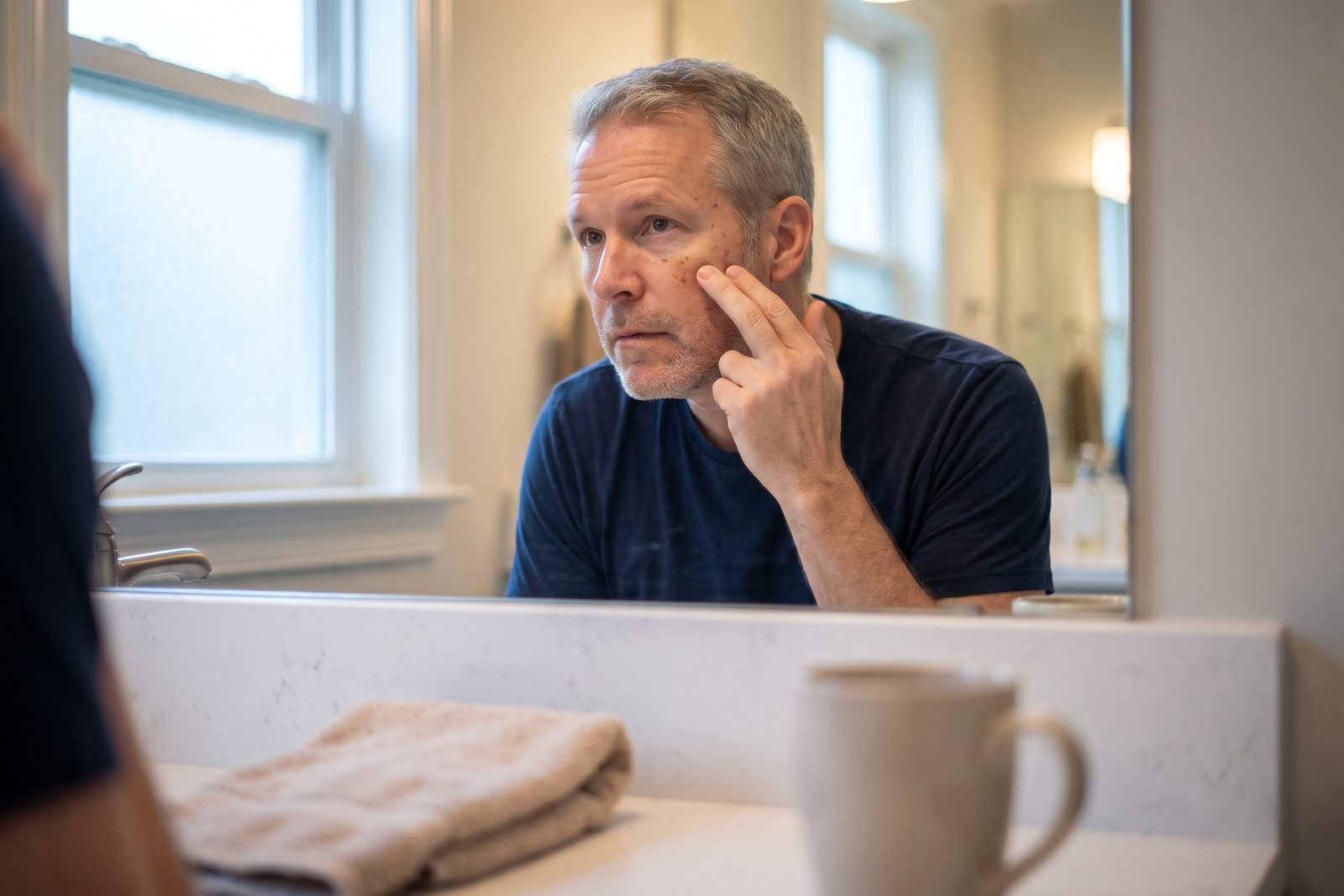
Sun spots are flat, tan to dark brown patches caused by years of ultraviolet light, and age spots, liver spots and solar lentigines are other names for the same thing. According to the Cleveland Clinic, they range from about a tenth of an inch to half an inch across, appear on the face, hands, neck and arms, and are more common in adults over 50.
A solar lentigo (plural lentigines) is the medical term for a single sun spot. The Cleveland Clinic explains that UV light speeds up melanin production until pigment gathers or clumps in one place. Fair skin, severe sunburns, lots of sun and tanning beds all raise the odds. Sun spots do not hurt or itch and are harmless, so treating them is a cosmetic choice.
The AAD says they show up where the sun's rays often hit, such as the face and hands, which is why the same plan often covers both. Our hand rejuvenation page covers spots on the hands.
How can you tell a sun spot from melasma or another dark spot?
A sun spot is usually a single flat, round or oval spot, as the Cleveland Clinic describes it, while melasma is a blotchy patch that tends to appear on both sides of the face. According to the AAD, melasma most often affects the cheeks, forehead, nose, chin and the skin above the upper lip, primarily affects women, and becomes more noticeable after time in the sun.
The difference between sun spots and melasma matters because treatments that suit one can harm the other. A 2024 review in the American Journal of Clinical Dermatology says intense pulsed light (IPL), a common sun spot treatment, risks relapse, dark marks and worsening in melasma. If your patches are broad, symmetrical or darker in summer, read our guide to melasma treatment first. And if a mark is indented rather than flat, it is a scar, not pigment; see our guide to fillers for acne scars.
| Mark | What it usually looks like | What drives it | Usual first step |
|---|---|---|---|
| Sun spot (solar lentigo) | Flat, round or oval, tan to dark brown, freckle size to half an inch | Years of UV exposure | Cosmetic treatment once confirmed |
| Melasma | Blotchy patches on both sides of the face | Sun, visible light, heat, hormones | Tinted sunscreen and a prescription plan first |
| Freckles | Small light brown dots that run in families | Genes, brought out by sun | Sun protection; treatment optional |
| A spot that needs a check | Uneven halves, ragged edge, several colors, changing | Possibly skin cancer | A skin exam before any fading treatment |
What do concerning sun spots look like?
A spot that looks like a sun spot needs a skin check when it looks different from your other spots or is changing. The AAD's ABCDE guide flags a spot with uneven halves, an irregular or poorly defined border, varied colors, a diameter usually over 6 millimeters (a pencil eraser), or one that is evolving, and the Cleveland Clinic adds bleeding, darkening or a border turning irregular.
Fading the wrong spot is risky. The AAD warns that other growths become more common with age, including seborrheic keratoses, actinic keratoses and skin cancer, and that using an age spot treatment on a skin cancer can give it time to grow and possibly spread. Melanomas can also be smaller than 6 millimeters, so size alone does not clear a spot.
Derm Clinic MD is a cosmetic practice and does not do skin cancer checks or mole exams. Any spot that is new, changing, itching or bleeding goes to a physician who does skin checks first. Once a spot is confirmed as a sun spot, the cosmetic options below apply.
A consultation is the place to ask. Dr. Payman sees patients in Buckhead and Cumming.
What fades sun spots on the face?
Sun spots fade with lasers, light treatment, chemical peels, freezing and prescription creams. A 2023 systematic review of 48 studies with 1,763 patients, in Dermatologic Surgery, found complete clearing in 65% of cases with combination treatments and 43% with laser-based treatments, ahead of topical retinoids at 21%, freezing at 15% and chemical peels at 6%.
For sun spots, device type matters within lasers. A 2025 systematic review of 41 trials with 3,234 patients, in the Journal of Cosmetic Dermatology, reported success rates of 74.6% to 90% for IPL, 67.9% to 93% for picosecond lasers, 36% to 77% for Q-switched lasers and 8% to 23% for fractional CO2 laser, while trichloroacetic acid peels reached 12% to 46%. The trials defined success differently, so read these as ranges, not a ranking.
Speed and side effects trade off. The AAD says laser and peels work faster than creams but cost more and carry a higher risk of side effects, while creams take weeks or months of steady use. In the 2023 review, side effects were most frequent with topical retinoids (82%) and least frequent with peels (19%).
| Option | What studies show | Usual recovery | At Derm Clinic MD |
|---|---|---|---|
| Prescription cream, such as a retinoid | Complete clearing in 21% (2023 review) | No procedure; irritation is common | Prescribed after the consultation, if it fits |
| Chemical peel | Complete clearing in 6% (2023 review); TCA peels 12% to 46% success (2025) | Light peel: heals in 1 to 7 days; redness, then scaling (AAD) | Offered |
| CO2 laser resurfacing or microlaser peel | Fractional CO2: 8% to 23% success (2025 review) | Days of ointment care, 4 weeks of strict sun protection | Offered; consultation first |
| Pigment lasers (Q-switched, picosecond) | 36% to 93% success (2025 review) | Crusting or temporary darkening (AAD) | Not among the lasers listed |
| IPL photofacial | 74.6% to 90% success (2025 review) | Pigment change risk in darker skin | Not offered |
| Freezing (cryotherapy) | Complete clearing in 15% (2023 review) | Blister, redness, swelling (AAD) | Not listed |
How long does it take sun spots to fade?
Sun spots fade over days to weeks after a procedure and over weeks to months with creams. According to the AAD, one or two laser treatments can treat age spots quickly, likely with longer-lasting results than a fading cream, and a light chemical peel heals in 1 to 7 days, though 3 to 5 peels may be needed.
Some sun spot treatments make spots look worse before they look better. The AAD says lasers can cause crusting or temporary darkening that tends to fade quickly, and after a light peel the skin is red, then may scale for 3 to 7 days, with peels repeated every 2 to 5 weeks. Plan a series so the last session lands well ahead of a wedding or family photos.
Laser recovery asks more of you, and Derm Clinic MD's laser aftercare sheet sets out each step, from ointment care to 4 weeks of strict sun protection. Our chemical peels and laser resurfacing pages cover each treatment in more depth.
What should you know about IPL and photofacials for sun spots?
Intense pulsed light (IPL) is a device that uses a flashlamp and filters to deliver pulses of broad-spectrum light instead of a single laser wavelength, and it is often marketed as a photofacial. A 2010 review in Lasers in Surgery and Medicine found that most comparative trials, across the skin conditions it covered, rated IPL about as effective as lasers.
Skin type changes the answer. A 2026 review in Plastic and Reconstructive Surgery Global Open advises avoiding IPL in Fitzpatrick skin types IV to VI, medium-brown to deeply pigmented skin, because of the risk of darkening or lightening the skin, and notes that superficial chemical peels are used often in darker skin with high satisfaction. The 2024 melasma review adds that IPL can make melasma worse, which matters if your spots sit near melasma patches.
Derm Clinic MD does not offer IPL. If you came looking for a photofacial, the treatments the office offers that are used for sun spots are chemical peels, CO2 laser resurfacing, a microlaser peel and prescription skincare, and at the consultation you hear what each can and cannot do. IPL is common elsewhere and well studied for discrete spots on lighter skin; for darker skin, or spots mixed with melasma, a peel-based plan is often the gentler start.
Can sun spots come back after treatment?
Sun spots can come back after treatment, and new ones can form. The AAD says age spots can return and that sun protection helps prevent this, and the Cleveland Clinic says new spots are more likely if you do not protect your skin from UV light. In a 2017 Q-switched laser study described in the 2025 review, the recurrence rate was 12.7%.
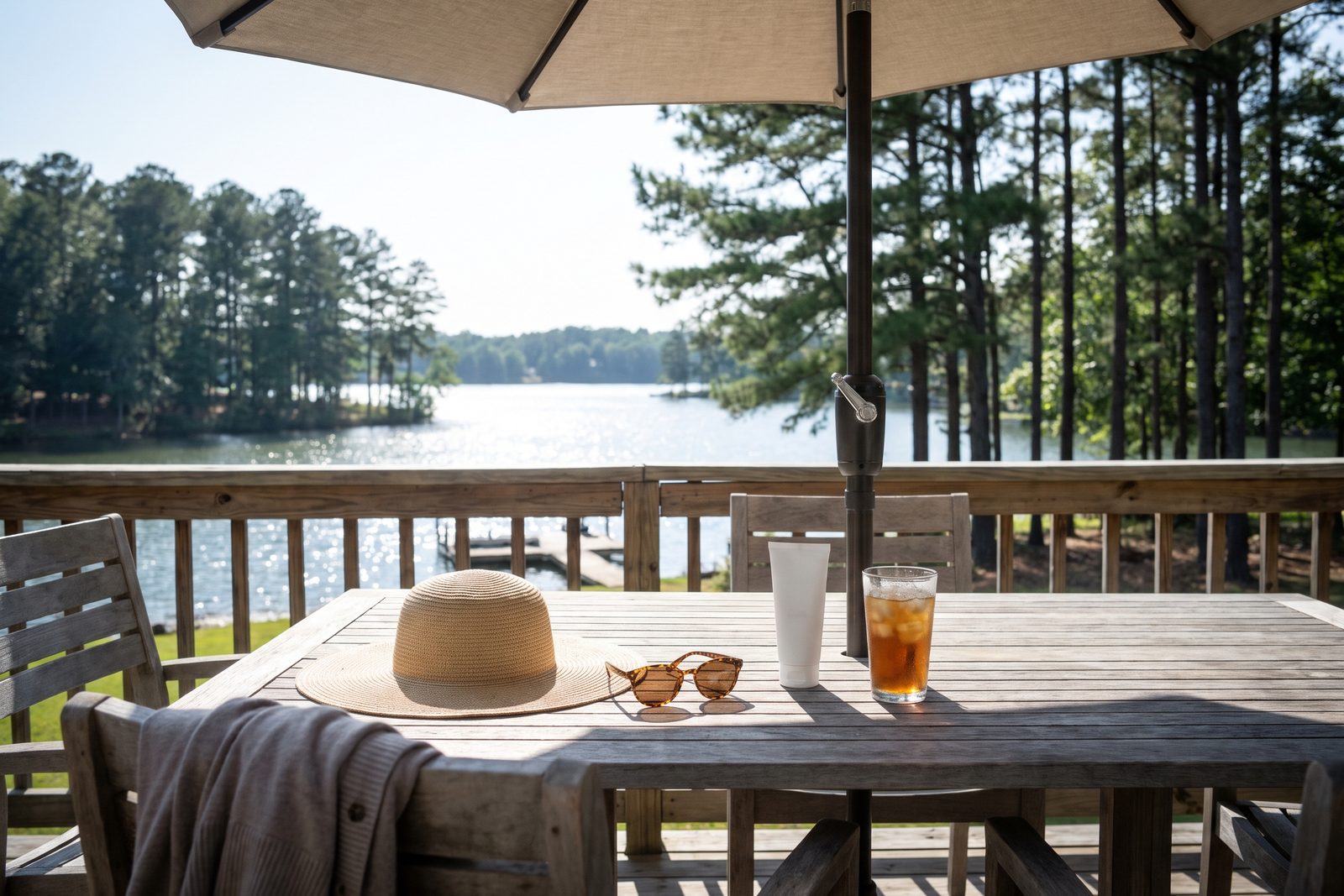
Preventing new sun spots is ordinary but strict. The AAD recommends shade, sun-protective clothing such as a wide-brimmed hat, clothing with a UPF label, and a broad-spectrum, water-resistant sunscreen with SPF 30 or higher on exposed skin. The Cleveland Clinic adds reapplying every two hours, limiting sun from 10 a.m. to 2 p.m. and skipping tanning beds. Lake weekends and golf are where the hours add up.
Skip unapproved fading creams. The FDA says there are no legally marketed over-the-counter skin lightening products, has warned of serious side effects including ochronosis, a skin discoloration, from hydroquinone products sold without approval, and advises talking with a health care professional about aged or dark spots. The Cleveland Clinic warns that lighteners containing mercury can damage the kidneys or nerves.
What happens at a sun spot visit at Derm Clinic MD?
A sun spot visit at Derm Clinic MD starts with an in-person consultation with Dr. Arshia Payman, the physician who owns this physician-led med spa, at the Buckhead (Atlanta) or Cumming office. Before any treatment is named, she asks what bothers you, reviews your history and explains what each option can and cannot do, including recovery and cost. For laser, that consultation is your first visit.
If you're coming in about one or two spots, first Dr. Payman wants to understand exactly which ones bother you and what you want instead, so point to them. If your spots sit near melasma or on darker skin, say so, since that changes which options are gentle enough.
- Consult first: Dr. Payman asks what bothers you and what you want instead, before any treatment is named, so the plan targets the spots you care about rather than your whole face.
- Is it a sun spot?: Derm Clinic MD provides cosmetic care only, so a spot that is new, changing, itching, bleeding or unlike the rest goes to a physician who does skin checks first, so that it is examined, not faded. Mention any spot you have watched change.
- Your history: she reviews your health history, medications, supplements and past treatments, including product, date and how long it lasted, because some medicines make skin sun-sensitive and past procedures change the plan. Bring the names.
- Options and trade-offs: you hear what each option can and cannot do, with risks, recovery and cost, so you can weigh speed against downtime. A peel's type, strength and number of visits are set at the consultation, and a prescription product, if it fits, is prescribed afterward.
- Getting ready for laser: the office's instructions ask for no sun or UV lamps for 6 weeks before, no makeup or lotion on the day, and a new, unopened tube of ointment, so skin is untanned and clean on the day. The sheet lists pregnancy, breastfeeding and isotretinoin in the past 2 years as reasons not to have it, so mention any of them.
- Your decision: you sign consent only if you go ahead, and you do not have to be treated that day. The office confirms your cost first, so you can time treatment around summer plans.
- Healing at home: for laser, the sheet calls for ointment every 2 to 3 hours for 3 days, your head raised the first few nights, mineral makeup from day 5 and strict sun protection for 4 weeks, so new skin heals without dark marks. Pain is not normal, so call the office if you have it.
- Aftercare: you leave with written aftercare, can read the aftercare instructions ahead of time, and the office is a phone call away, so questions get answered while you heal. When you are ready, book a consultation (opens in a new tab) at either office.
Questions people ask
What fades dark spots the fastest?
Procedures usually work faster than creams. The AAD says one or two laser treatments can treat age spots quickly, while creams take weeks or months of daily use. Faster options cost more and carry more risk of side effects, and in darker skin a gentler, slower plan can be the wiser trade.
Do drugstore dark spot creams work?
Be careful with them. The FDA says no over-the-counter skin lightening product is legally marketed in the U.S., and hydroquinone products sold without approval have caused rashes, swelling and ochronosis. The AAD adds that some people need a prescription-strength cream, after a professional confirms the spot is an age spot.
Are sun spots a sign of skin cancer?
True sun spots are not cancer, and the Cleveland Clinic says they are not dangerous. They do mark past sun exposure, and the AAD notes that skin cancer and precancerous growths become more common with age and can look similar. Any spot that is new, changing, itching or bleeding needs a skin exam first.
What is the difference between sun spots and freckles?
Freckles are mostly inherited and brought out by sun, while sun spots come from years of sun damage. A 2014 review in Pigment Cell and Melanoma Research describes freckles (ephelides) as largely genetically determined but induced by sunlight, and lentigines as induced by sun exposure and photodamage.
Should I treat sun spots in summer?
Fall or winter usually makes it easier. The office's laser instructions ask for no sun or UV lamps for 6 weeks before laser and strict sun protection for 4 weeks after, which is hard to keep through long, sunny months. Peels also need protected, healing skin, so pick a stretch with fewer outdoor plans.
Can sun spots on the hands be treated the same way?
Often, yes. The AAD says a chemical peel can effectively treat age spots on the hands, and in a study comparing peels with freezing, 47% of people who had the peel saw their spots fade by half. Freezing did slightly better, but skin healed faster after the peel.
Sources
- What can get rid of age spots?. American Academy of Dermatology, last updated 2021. https://www.aad.org/public/cosmetic/age-spots-marks/get-rid-spots
- What to look for: ABCDEs of melanoma. American Academy of Dermatology. https://www.aad.org/public/diseases/skin-cancer/find/at-risk/abcdes
- Chemical peels: FAQs. American Academy of Dermatology. https://www.aad.org/public/cosmetic/younger-looking/chemical-peels-faqs
- Melasma: Signs and symptoms. American Academy of Dermatology, last updated 2022. https://www.aad.org/public/diseases/a-z/melasma-symptoms
- Liver Spots. Cleveland Clinic, last updated 2021. https://my.clevelandclinic.org/health/diseases/21723-liver-spots
- Treatment of Lentigines: A Systematic Review (Mukovozov I, et al.). Dermatologic Surgery, 2023. https://pubmed.ncbi.nlm.nih.gov/36533790/
- Treatment of Solar Lentigines: A Systematic Review of Clinical Trials (Mardani G, et al.). Journal of Cosmetic Dermatology, 2025. https://pmc.ncbi.nlm.nih.gov/articles/PMC11948172/
- Noninvasive Cosmetic Treatments for Fitzpatrick IV-VI: A Narrative Review of Safety and Efficacy Guidelines (Lee SS, et al.). Plastic and Reconstructive Surgery Global Open, 2026. https://pubmed.ncbi.nlm.nih.gov/41884758/
- Intense pulsed light (IPL): a review (Babilas P, et al.). Lasers in Surgery and Medicine, 2010. https://pubmed.ncbi.nlm.nih.gov/20166155/
- An Update on New and Existing Treatments for the Management of Melasma (Gan C, Rodrigues M). American Journal of Clinical Dermatology, 2024. https://pmc.ncbi.nlm.nih.gov/articles/PMC11358250/
- FDA works to protect consumers from potentially harmful OTC skin lightening products. U.S. Food and Drug Administration, 2022 (content current as of May 2026). https://www.fda.gov/drugs/drug-safety-communications/fda-works-protect-consumers-potentially-harmful-otc-skin-lightening-products
- Sun-induced freckling: ephelides and solar lentigines (Praetorius C, et al.). Pigment Cell and Melanoma Research, 2014. https://pubmed.ncbi.nlm.nih.gov/24517859/
This article is general education and is not medical advice. It does not replace an in-person consultation. Whether a treatment suits you, and what result is realistic, depends on your health history and an examination.
Derm Clinic MD · Last updated November 2026.